
















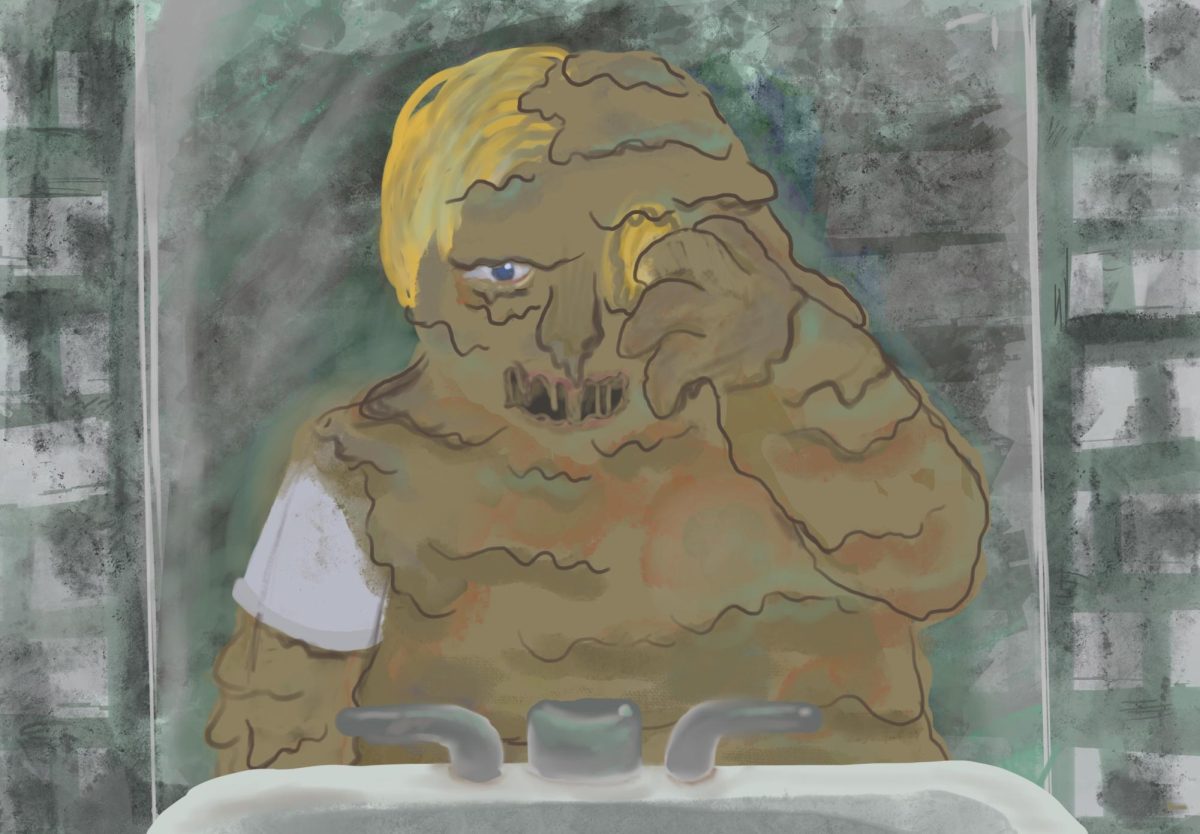











































































Having grossed $98.3 million worldwide, DC Studio’s Clayface made history as one of the most profitable pure body horror films. This movie made its debut in a fairly contemporary landscape, with its most recent competitor being well known—The Substance. Clayface follows a well-established character within comics, Matt Hagen, as he tries risky experimental therapy to restore his mutilated face after being assaulted. He begins to lose control over the limits of his own body and his mind, becoming increasingly violent as he learns to take on the faces of people around him. DC Studio’s first foray into horror calls heavily upon classical cinematic interpretations of body horror, the first and foremost being The Fly.
Body horror was first defined as a genre by Philip Brophy in his essay, “Horrality: The Texture of the Contemporary Film.” It refers specifically to the “fear of one’s body, of how one controls and relates to it.” The character of Matt Hagen is perfectly tailored to this definition; his loss of control over the physical matter of his body is coupled with his newfound violence—how he “relates to” and understands himself, his own morality. Though this genre may seem modern, and thus removed from the traditional idea of horror, body horror has roots in the earliest human traditions and their mythology.
Early Greek poets encapsulated the idea of body horror as visceral transformation, in works like Ovid’s Metamorphoses and Boios’s Ornithogonia. In classic British works, body horror evolved into a cultural monster—the werewolf. While these works focused on humans being turned into animals, usually as some form of divine punishment, the body horror of mythology grew to address other fundamental conflicts of human life. These included physical disability, gender, mutilation, disease, and decay. Just as ancient people found comfort in mythology to explain the happenings of the world around them—why the sun rises and sets, why their crops grow, why it rains—they relied upon the same to explain the conflicts within their body and mind. Body horror can be found in every form of media, spanning from ancient storytelling to Mary Shelley’s Frankenstein to Salvador Dali’s Autumnal Cannibalism. The genre itself has followed every major development in media and culture.
American body horror found its cinematic foothold after the dissolution of Hay’s Code, a set of cinematic censorship rules that banned, most important to the genre, bodily exposure and gore. The lifting of this ban was accompanied by leaps and bounds in cinematic practical effects. This allowed for a bridging of the gap between a cultural monster and a character—now, a werewolf could transform in real time, and the audience was thus confronted directly with the character’s violent loss of control.
Body horror was able to establish itself as blunt and directly identify with the audience. In the traditional way, then, Clayface refuses to shy away from the viewer; in fact, most of the prosthetics employed in the movie are physically manipulated both by the actor and the setting for an admirably practical film. Though these special effects, the characters, and the setting are all unmistakably 21st century products, the narrative of the film follows an age-old fear of the separation between one’s body and their identity.