





































Almost everyone can remember where they were on March 13, 2020. It was the day that the world was told to sit tight for a few weeks until the new “coronavirus” was kept under control. What was supposed to be a two week hiatus turned into months, and then years, of social distancing, mask mandates, and global uncertainty for the future. While none of the current student body experienced 2020 at Saint Francis, we are all old enough to remember how it impacted our own elementary and middle school experiences.
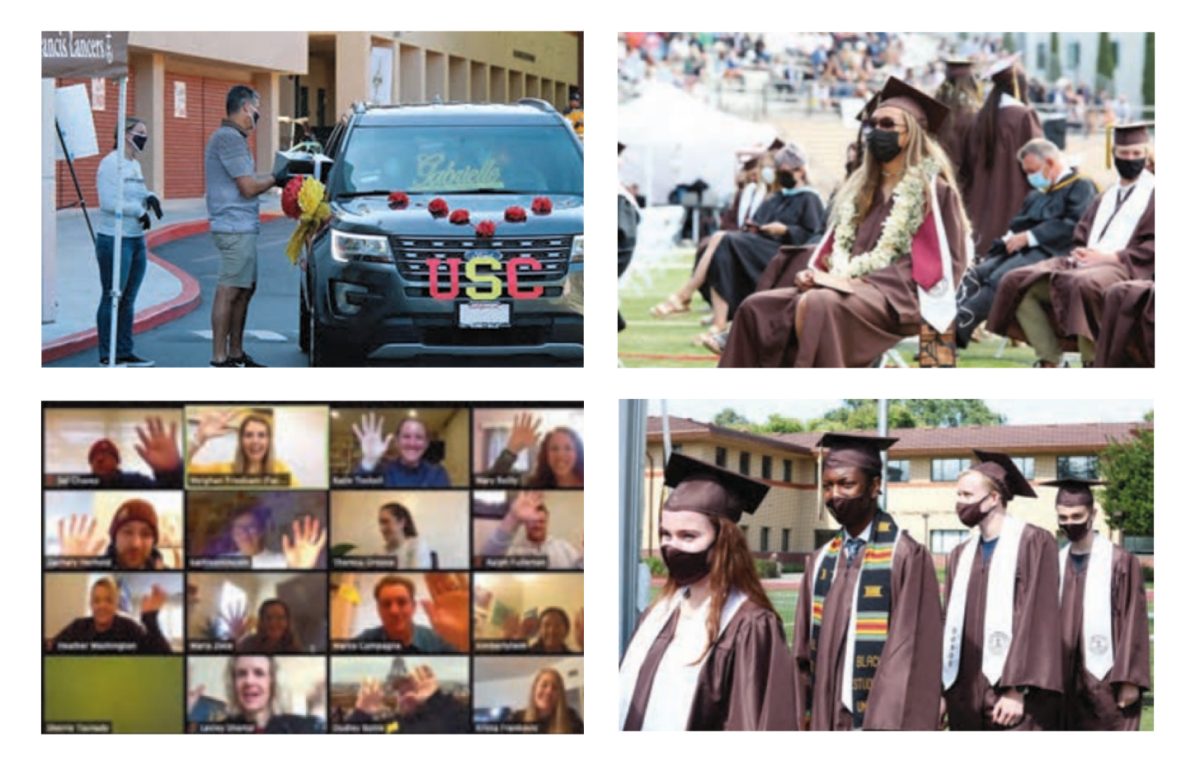
As was typical with most schools in the spring of 2020, Saint Francis finished out the second semester mostly asynchronously with sporadic Zoom calls. Ava Goumas was a sophomore when COVID-19 first hit and reflects on the first adjustment to online learning: “A lot of my peers really struggled with that. And so I think, as a result of that, when COVID-19 was still ongoing during the beginning of my junior year, Saint Francis really saw that a lot of students were struggling with a lack of structure.” By the fall of 2020, students went through a block schedule of Zoom classes every day, mimicking a “real” school day.
While live teaching improved the students’ learning environment, the social aspect of high school was impossible to replicate online. During the fall semester, the guidelines for school-run events were still very restrictive, so Saint Francis was limited to hosting Mass and movie nights in the parking lot. Veteran physics teacher Mr. Chihiro Ikezi often refers to the COVID-19 years as a very low point for everyone at school: “I think kids like school because 80% of it is the social stuff. Being with your friends, eating lunch together, whatever. So basically COVID-19 took all the best parts of school out and left only the academic stuff.”
As restrictions lightened in the spring semester of 2021 students were welcomed back on campus in small groups. Students had the option to go in person a few days a week or remain completely online. At one time, a classroom barely had more than half the normal average of students in person each day, so teachers had to learn how to balance a hybrid class split between Zoom and in-person students. Goumas experienced this set up firsthand: “I definitely felt detached from the academic environment because we have such great teachers at Saint Francis, and they’re so used to teaching to a classroom, and I think that everyone was so excited to be in person. You kind of forgot about the people on Zoom, just naturally.”
It wasn’t until the fall of 2021 that the entire student body made their return to campus as a whole. While the days of online learning were over, Saint Francis was hardly back to “normal.”
Liturgies had to be held outside, masks were suggested, and restrictions on gatherings fluctuated based on unpredictable outbreaks throughout the year. Despite the year’s challenges, many students were grateful for any semblance of normalcy. “We beat De La Salle [High School] right at the beginning of my senior year and I think that was definitely a very unifying moment for our school. Everyone got to celebrate this monumental win. I think that was a very symbolic moment of unity for the campus overall,” said Goumas.
One aspect of the pandemic that remains relevant to campus today is the way it transformed our academic policies. To aid students in the adjustment to in-person learning, Saint Francis implemented new rules concerning retakes and missing work. Goumas recalls, “I think that the biggest difference that I felt, I guess culturally between my freshman and sophomore year was the approach to academics.” In the year directly following COVID-19, students were able to retake tests up to 100%. The next year, that policy was changed to allow retakes to up to 85%.
After review by the administration, the minimum grade will be dropped to 75% for the next school year in addition to stricter rules regarding missing work and retakes on tests. These new changes seem to reflect that Saint Francis is recovering from the effects of the pandemic and moving back to a more traditional approach now that students can handle it. “After COVID-19, we tried to help out the kids as much as possible, but it was hard. We were all just trying our best. It’s hard to make a policy for everyone that helps everyone because everyone’s needs are different,” said Mr. Ikezi.