

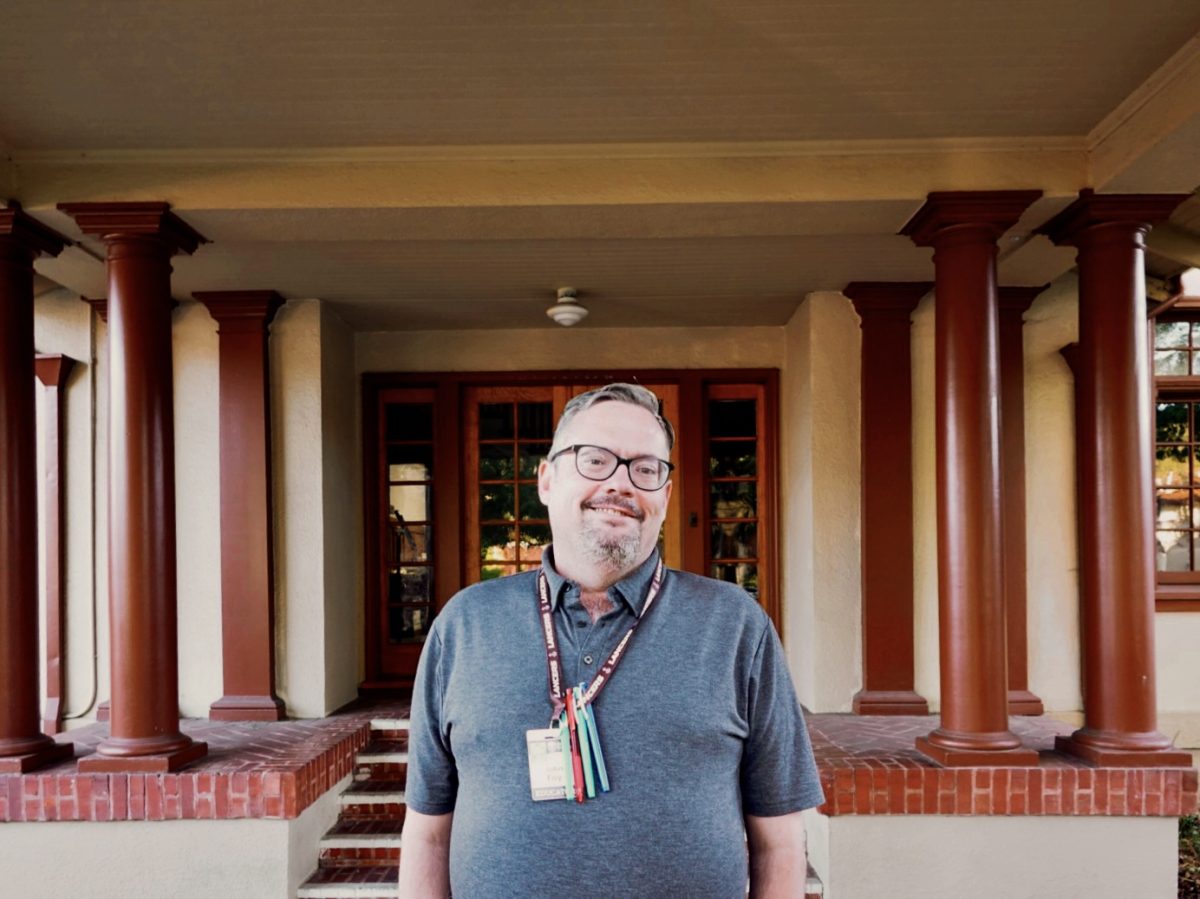





















































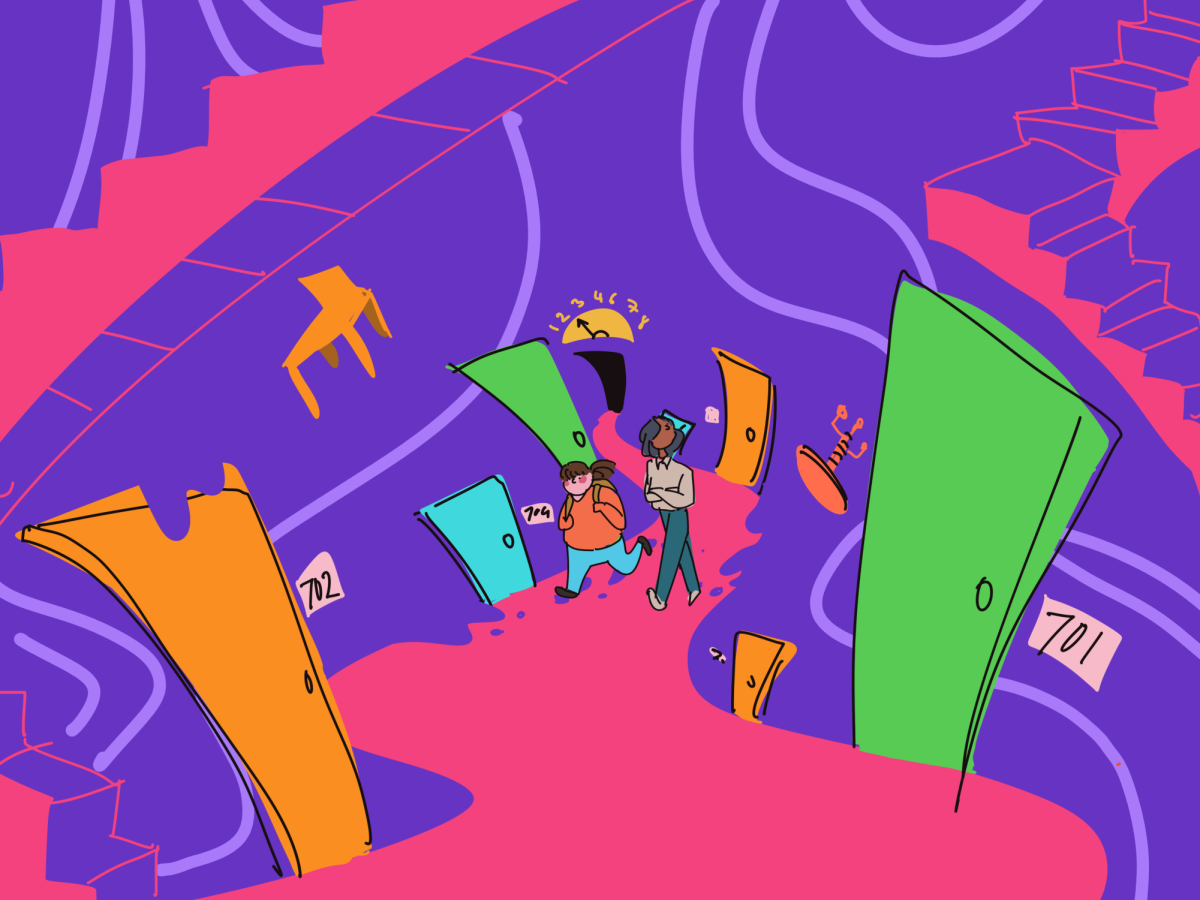

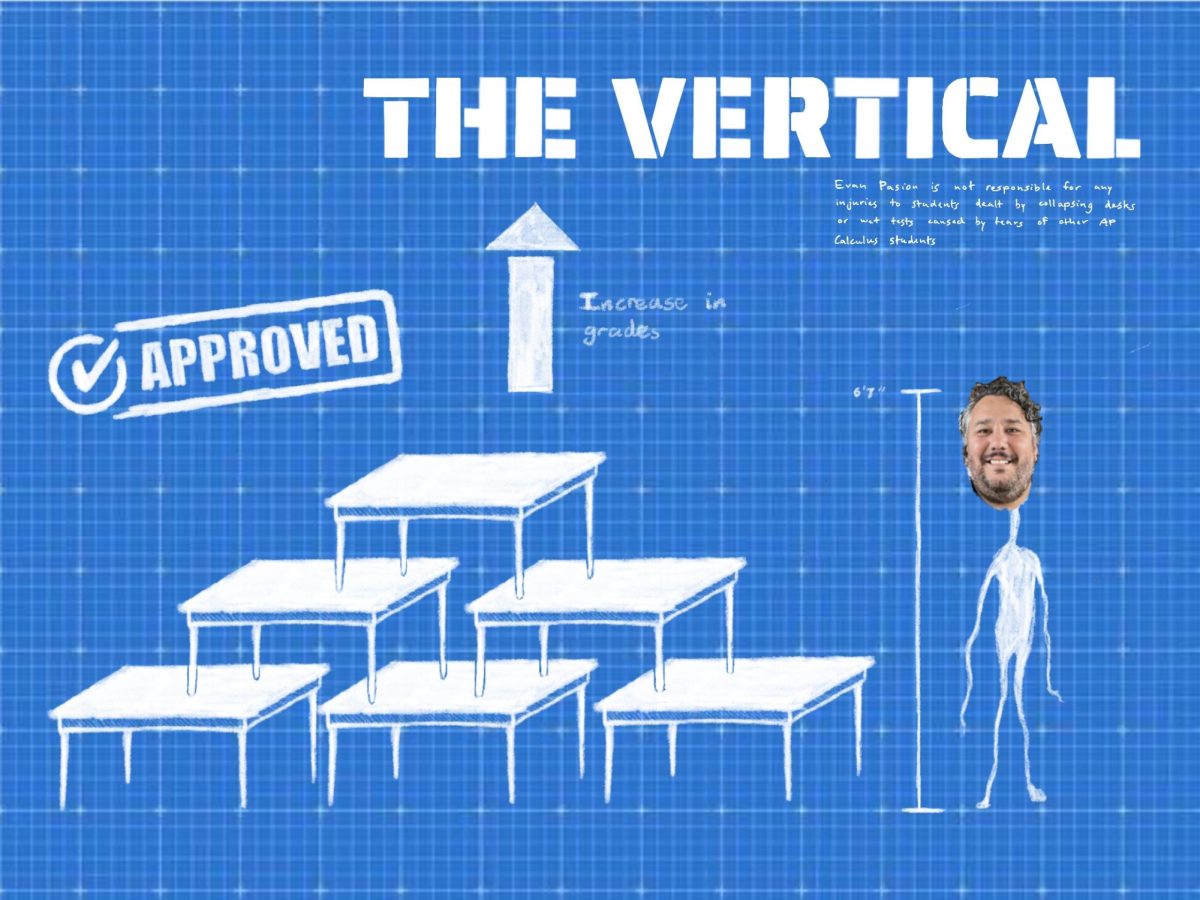
Mr. Evan Pasion has recently unveiled a novel seating formation that has shocked the world: The Vertical. The Vertical is an innovative classroom arrangement where desks are stacked up in a pyramid style. Students at the bottom first line up in a row and take their seats, followed by the next group of students, who must first stretch their legs and then climb onto the shoulders of the students under them to take their seats. This continues layer by layer until the last students are in their seats at the top of The Vertical.
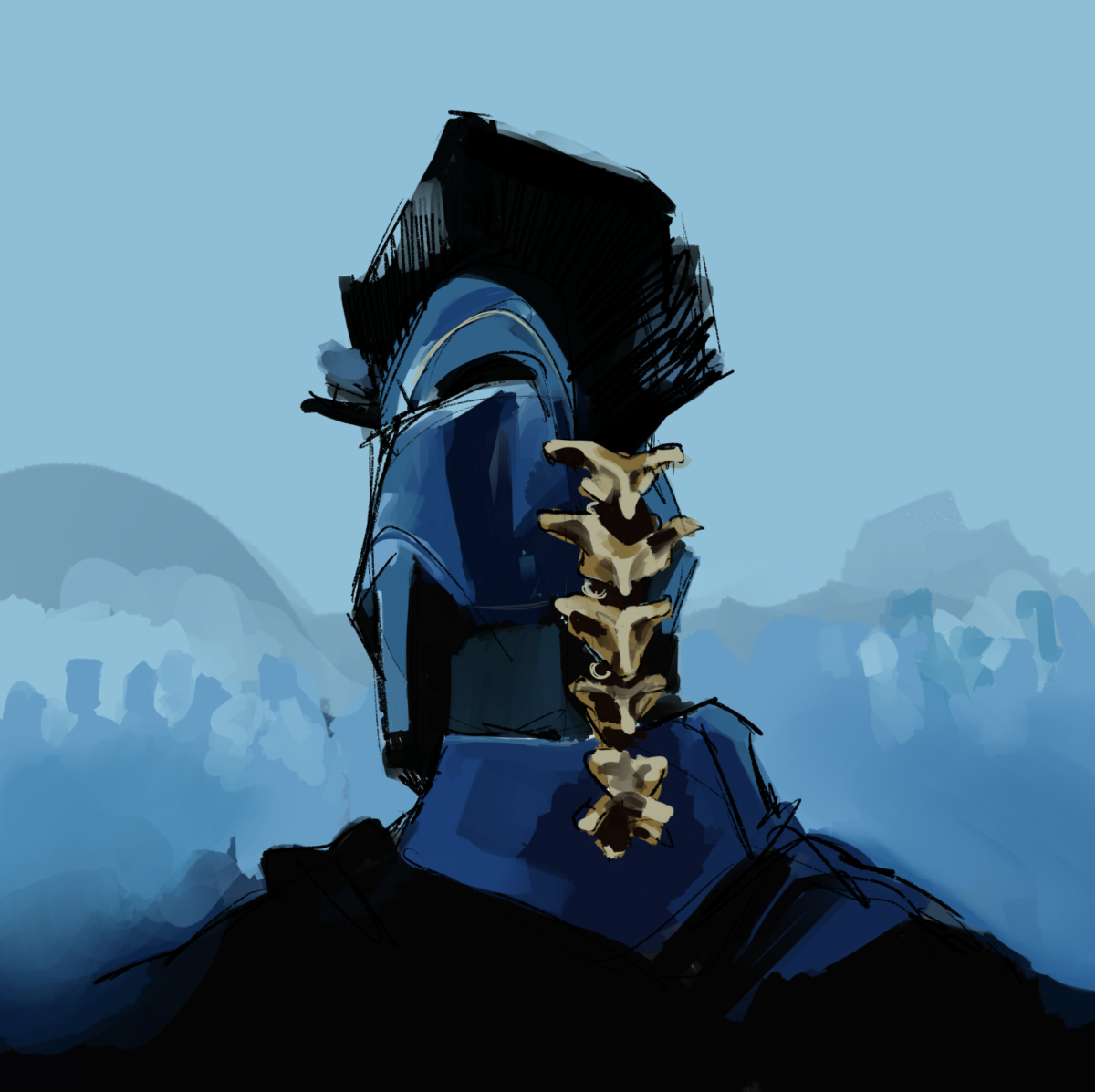
It might be logical to ask… why? Why not just sit the way we normally do? Well, Mr. Pasion at 6-foot-7 has gotten a pretty serious case of “text neck.” Text neck is a condition caused by constantly looking down at one’s phone, leading to chronic muscle pain—in Mr. Pasion’s case however, the phone is thirty teenagers asking what page the homework is on.
Text neck cases have been rising, with more and more people injuring their necks and upper backs from looking down while texting. “It’s a serious issue that doesn’t get talked about much these days,” says Doctor Sine, MD. “Consistently looking down at a sixty degree angle can place up to sixty pounds of pressure on a person’s neck, which can affect not only the neck, but also the back and potentially lead to spinal injury,” he adds.
In Mr. Pasion’s unique case, the issue stems from looking down while standing for extensive periods of time. As an educator deeply committed to teaching while standing, Mr. Pasion faced a difficult choice: give up standing… or give up to gravity. When asked about the thought process behind The Vertical, he simply recalls thinking, “Why not choose both?” The Vertical was born shortly after.
In The Vertical, students with higher hand-raising frequencies are seated closer to the top. This ensures that Mr. Pasion’s time spent looking downwards is minimized. Furthermore, the added height from the pyramid ensures a more balanced weight distribution on his neck.
In spite of all of this, the remarkable Vertical does come with some drawbacks. Firstly, desk legs tend to cover the faces of students, so Mr. Pasion must differentiate students by their voices. Unfortunately, not all student voices are separable, which creates some confusion during class. Furthermore, the number of student absences must be reduced to ensure a high enough pyramid that would align with Mr. Pasion’s eyeline.
Students have had mixed reviews about the recent integration of The Vertical. “It’s good to exercise both physically and mentally,” says Kullyn He (ʼ28), who sits at the top of the pyramid. “It’s a creative and logical solution,” adds Doctor Sine, “but there may be limits to how long a student can sustain themselves under the weight of five people while taking a calculus exam.”
“It gets really tiring,” said Vanno Ponyavelu (ʼ28) from her period ten class, “and if one person slips in the middle of class, there’s a chain reaction, everyone falls.” Breaks in the formation appear to be a reoccurring incident, and many students have reported injuries as a result: “I dislocated both shoulders,” deadpans a student who wished to stay anonymous. “The student above me was crying and their tears kept falling on my test paper,” complains another.
Remarkably, the formation has led to an 10% increase in recent test grades. “Students have been quick to ask questions and raise their hands to participate in class discussions recently,” explains Mr. Pasion. “It’s a critical point in the curriculum, and I’m glad to see their understanding grow exponentially.” Experts are still debating whether the grade improvement is derivative of better engagement or the fear of collapsing the entire class structure.