





























































































While this column has focused on the randomness of human innovation and the role that it plays in advancing societal wellbeing, it is equally important to be aware of the destructive potential of human ambition.
The Nobel Prize is a highly prestigious annual and international award established by Alfred Nobel’s 1895 will. The accolade annually honors individuals or organizations for outstanding contributions in physics, chemistry, physiology or medicine, literature, and peace. Each recipient is bestowed with a gold medal, a diploma, and a substantial cash prize. While the winners of this award are widely known and revered for using their talents for the benefit of humanity, what is not so commonly acknowledged is that the motivation and funds behind it were a last ditch effort by a dying man who wished to clear his conscience.
Nobel was born in 1833 in Stockholm, Sweden. At age nine, he moved with his family to St. Petersburg, Russia, where his father worked for the Russian military to manufacture explosive munitions and underwater mines. Despite showing promise as a young writer, at age 16, Nobel’s father sent him to Paris to work in the laboratory of Théophile-Jules Pelouze. It was here that he met the Italian chemist Ascanio Sobrero.
In 1847, Sobrero accidentally created nitroglycerin, a mix of nitric and sulfuric acids. He quickly realized the destructive nature of this oil, which was incredibly volatile and would thus detonate randomly, as it was extremely sensitive to movement and heat. Sobrero would come to fully understand the consequences of his creation after a nitroglycerin drop combusted in a test tube and left him severely scarred by glass splinters, leading him to later remark that he “was almost ashamed to be its discoverer.”
Nobel picked up nitroglycerin where Sobrero dropped off and began working toward making the explosive safer for commercial use. His aspirations came at a price, as he blew up his laboratory twice. After the second time in 1864, his experiments were banished from the city of Stockholm as they had led to the loss of several lives, among them his youngest brother’s. Unlike Sobrero, Nobel continued his work, eventually developing a blasting cap which would warrant a controlled detonation. Additionally, Nobel became the first industrial scale producer of nitroglycerin after combining it with kieselguhr, a soft sedimentary rock composed of fossilized algae. This resulted in a putty-like substance that could be molded into sticks and coated with stiff paper in order to stabilize it.
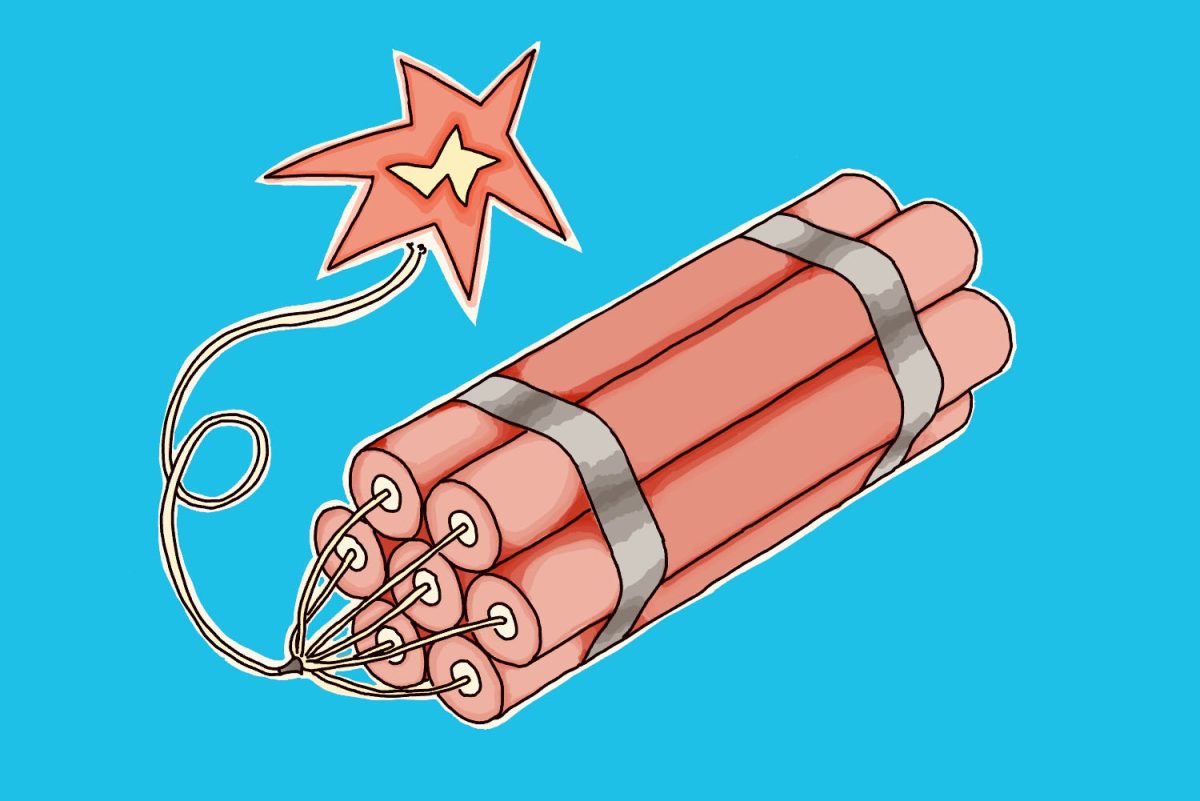
Thus, dynamite came to be. It was patented by Nobel in 1867, the term itself derived from the Greek word for “power”: dynamis. Despite the havoc that had already ensued in the creation of dynamite, it was originally marketed as “Nobel’s Safety Blasting Powder.”
It’s no secret that dynamite revolutionized the destruction of naturally occurring rock structures to make way for new feats in civil engineering. Dynamite trumped the productive capacity of gunpowder, as it could be placed into drilled holes of rock and then blasted outward to create a much bigger explosion. Without dynamite, it is uncertain if such technological wonders like the Panama Canal, Brooklyn Bridge, London Underground, and Hoover Dam would even exist. Furthermore, dynamite made possible the Second Industrial Revolution, as miners could more easily harvest coal and metals. Finally, the introduction of concrete and cement in construction was thanks to this newfound proficiency in blowing up gypsum and lime deposits.
Nevertheless, the number of workers who lost their lives in accidents involving dynamite is innumerable due to its unpredictability. Nobel seemed to believe that his brainchild would actually put an end to war as both sides would refrain from using such explosives with the threat of mutually assured destruction. It would appear that Nobel severely underestimated the inveterate tendency of humanity to annihilate one another, as dynamite ultimately provided the fuel for a new era of terrorism. Dynamite allowed for the advancement of weaponry as it was used as an explosive in mines, grenades, torpedoes, and artillery shells. Anarchists, revolutionaries, and nationalists alike maximized its lethality as dynamite bombs were easy to make and even easier to conceal.
At the time of his death in 1896, Nobel owned nearly one hundred explosives and ammunition factories, and had thus amassed a large amount of wealth. The exact motivation behind his creation of the Nobel Prize remains unclear, but a popular theory states that he read his own obituary after the newspapers had mistakenly reported his death in 1888. It was in this obituary that he was marked a “merchant of death.”
Was the advent of the Nobel Prize an adequate repentance for the atrocities the benefactor’s invention had made possible, or is the very legacy of the award forever tarnished with the stain of unforgivable sin that cannot be made right? It appears that the answer is as nebulous as the impact of dynamite itself.