




























































































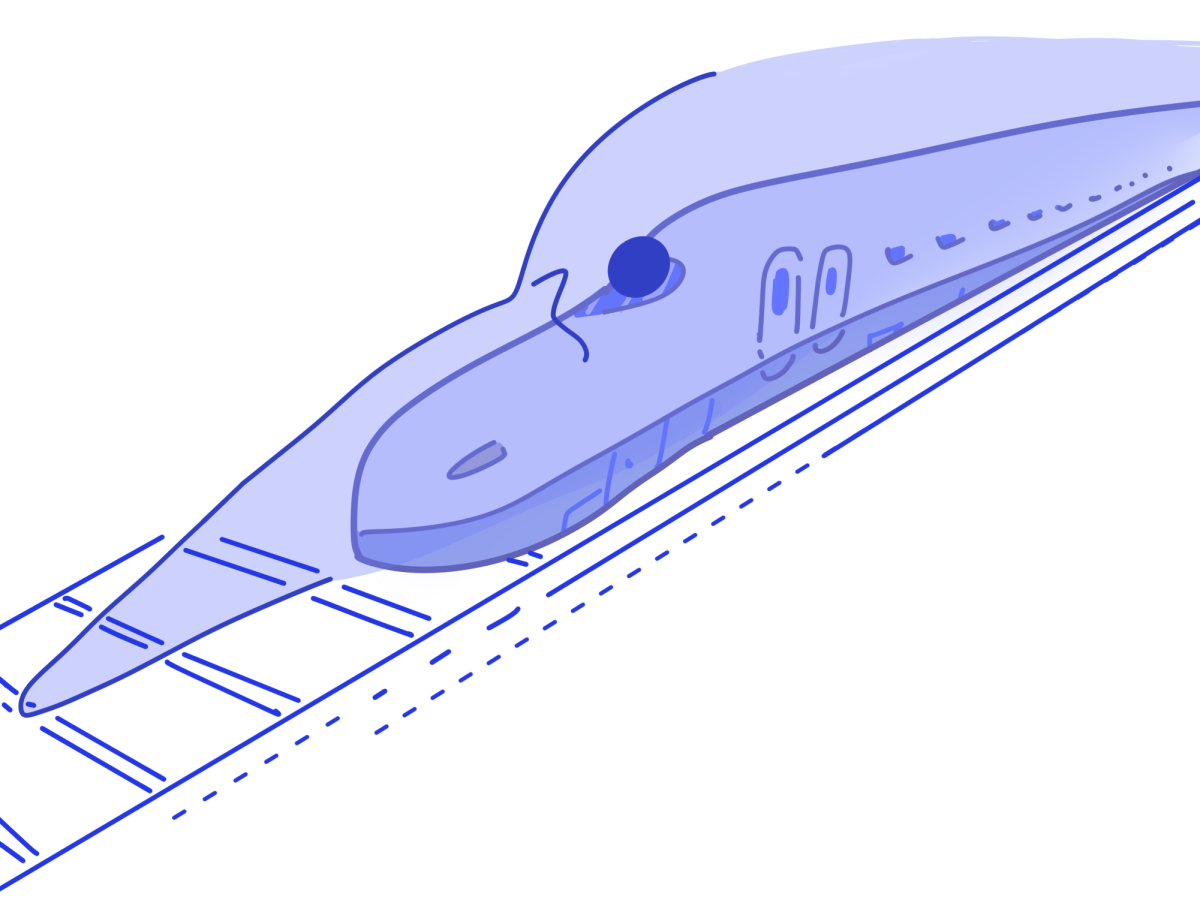
Japan’s bullet train network runs trains capable of travelling up to 200 miles per hour. Considered a great technological advancement, the Shinkansen is known for its efficiency and reliability. However, in the early 1990s, a major issue arose: the bullet trains created loud sonic booms when they exited tunnels. These booms disturbed thousands of residents, bringing about a multitude of noise complaints. Enter the kingfisher bird: the solution to the booms.
The Shinkansen began operations in 1964 and has transported billions of passengers since. As technology began to advance and the trains became faster, massive sonic booms, measuring about seventy to eighty decibels, began to occur every time a train exited a tunnel. When trains are travelling at high speeds outside of tunnels, the air in front of the train has many directions in which it can move; however, when the train is travelling in a tunnel, air cannot move as freely. Once a train begins to travel at speeds north of 150 miles per hour, the air cannot move into the small gaps between the train and the tunnel fast enough, and it is squished in front of the train. This creates a high-pressure zone of air in front of the train inside a tunnel, a phenomenon known as the “piston effect.” When this high-pressure zone is pushed to the end of the tunnel, the air from it suddenly expands, creating a massive compression wave and resulting in a loud booming sound. Engineers faced a major problem: they needed to decrease the noise without slowing down the train.
In 1997, Eiji Nakatsu, the Director of Technical Development for Japan’s bullet train network, solved this issue. Nakatsu was an avid bird-watcher. He observed that even at speeds of up to 25 miles per hour, the kingfisher was able to enter the water smoothly, without a splash. Nakatsu realized that the kingfisher’s long, narrow beak allowed it to switch between mediums without creating a significant compression wave. Applying this to the Shinkansen trains, he realized that if they were to make the ends of the train narrower and pointier, the train would be able to transition between “mediums” without creating a large compression wave, therefore lessening the amount of noise. Inspired by this bird, Nakatsu and his team began testing different models of train designs that had narrower, tapering ends. Notably, the model that worked best was one whose shape was incredibly similar to that of the kingfisher’s beak.
The team redesigned the Shinkansen, yielding impressive results. Not only was the boom issue solved, but air resistance had decreased by 30%, reducing the electricity usage by 15%. The trains could now travel faster, lessening the travel time between Shin-Osaka and Hakata by 15 minutes, with a lesser amount of energy. The trains’ 1997 design is one of the finest examples of biomimicry. Nature has been engineering for thousands of years; why not take advantage of it?
The Maglev Shinkansen is set to launch between 2034 and 2035, with speeds twice as fast as the current Shinkansen bullet trains. It employs the same kingfisher-inspired nose design, an element that hasn’t changed in almost thirty years, proving that biomimicry really is one of the greatest engineering innovations.