













































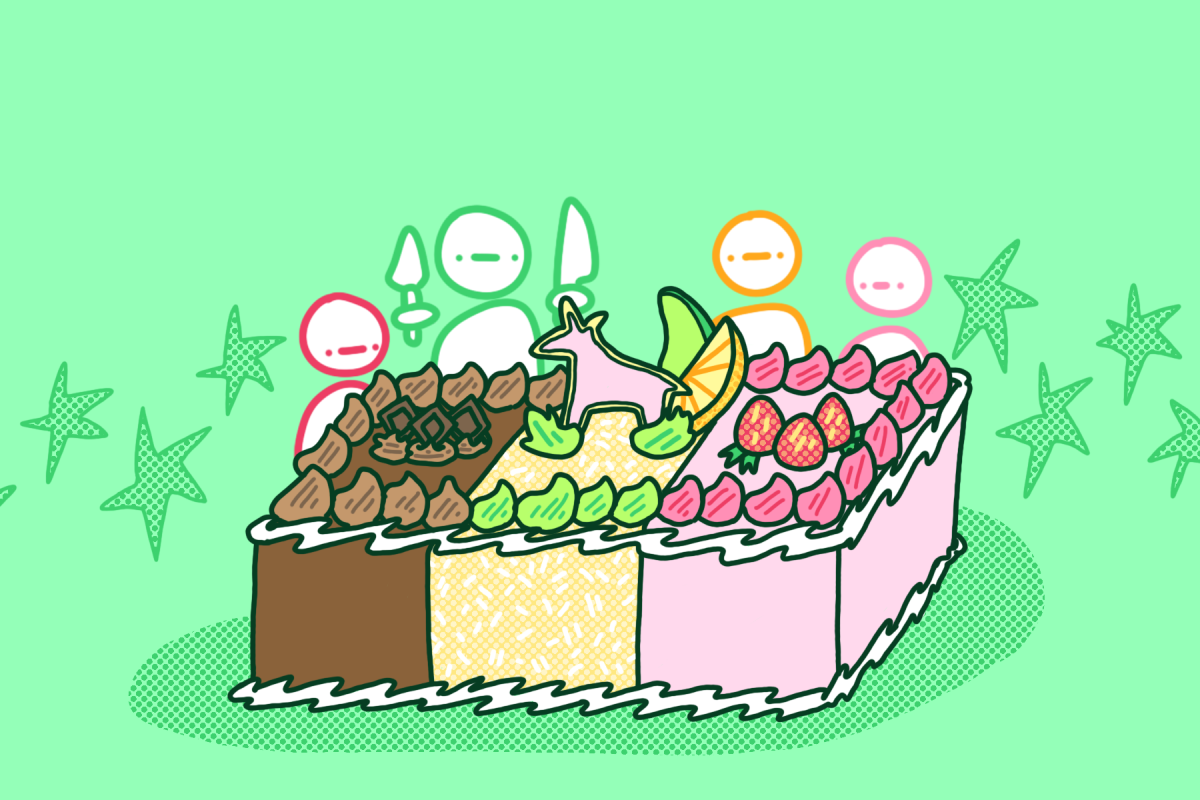






























Imagine you have to split a rectangular cake with your three friends. It has chocolate frosting on one end, strawberry frosting on the other, and in the middle is that delicious lemon-avocado-coconut-mango animal cracker blend you’ve been dying to get a taste of for the past year. All four of you want a fair share of the cake—but what does “fair” really mean?
This enigma of fair cake-cutting has been studied by mathematicians for as long as siblings have been fighting over dessert (even the “you cut, I choose” method can be found in the Bible). Yet, the solution is not as obvious as it may seem.
Intuitively, a fair split exists when everyone has the same satisfaction level—a concept known as equitable division. Suppose you only want the lemon-avocado-coconut-mango animal cracker blend while your other friends only want the chocolate and strawberry. You could take the entire lemon-avocado-coconut-mango animal cracker blend while the other three split the chocolate and strawberry into thirds. Under this scenario, everyone is satisfied, but not equally so. You might evaluate your satisfaction level as one, but your friends would evaluate theirs as one-third each. Thus, equitable division does not necessarily contribute to an optimal fair division.
Another approach is proportionality, where each of the friends consider their slice to be worth at least one-quarter of the whole cake. The key idea in proportional fairness is that each participant should keep their own slice rather than randomly trade it with another. Still, this method has its flaws. The cake may be split proportionally, but it is possible that one person would rather have another person’s slice. This conflict leads to a more robust definition for fairness that most researchers use today, known as envy-freeness.
Under an envy-free scenario, each friend, as the name suggests, is unenvious of another friend, guaranteeing social harmony. As such, nobody values another person’s slice above their own, allowing for the initial split where you could receive the full lemon-avocado-coconut-mango animal cracker blend as the other three split the chocolate and strawberry into thirds. Envy-freeness is often favored in this branch of mathematics for its strength and simplicity, making it a powerful index for fairness.
To ensure fairness, a variety of strategies have been suggested. My personal favorite is the moving knife. In this method, an imaginary knife begins cutting on one end of the cake. It keeps cutting until the knife reaches a cut that one person deems is a fair share of cake (1/n of the cake for n number of friends). The knife would then slice that section of the cake, the person would receive that slice of cake, and leave the process. This process would continue until the cake is split into enough slices for everyone. However fair this method may seem, it does not ensure envy-freeness. Even this method of slicing has its extensions, such as Stromquist’s Procedure, where multiple knives cut at the same time.
The cake may seem trivial, but the problem extends universally. Whenever resources are limited, and people value them differently, the same challenge arises: How do we divide fairly?
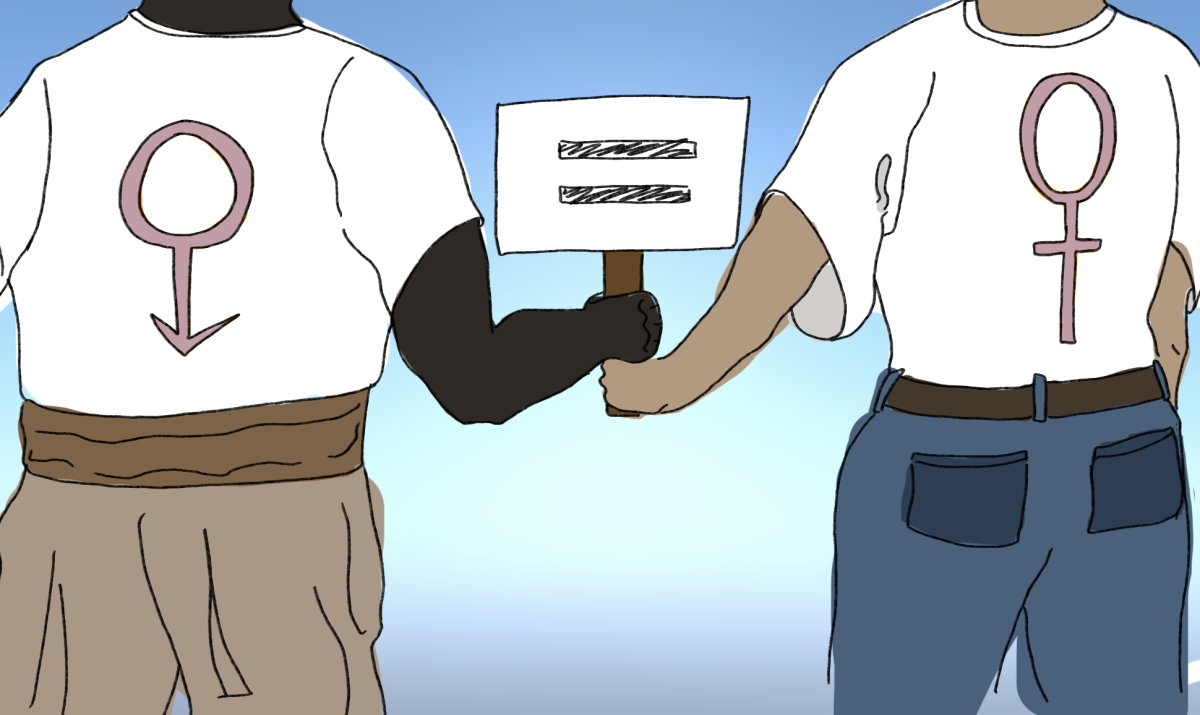
Every day, people divide things that may matter far more than dessert: time, money, food, supplies, property, and opportunities. Just like with cake, giving everyone the same amount does not equate to giving an equal opportunity to benefit from it. One person may need more. Another person may value something differently. Someone may have begun with far less. There is no single knife that can perfectly divide the world’s resources, nor is there a universal procedure to keep every person equally satisfied.
To mitigate these issues, mathematicians and economists have spent decades developing different ways to measure and achieve fairness so that one day, more people will be able to have a fair slice of that equality cake. And it will taste delicious!