













































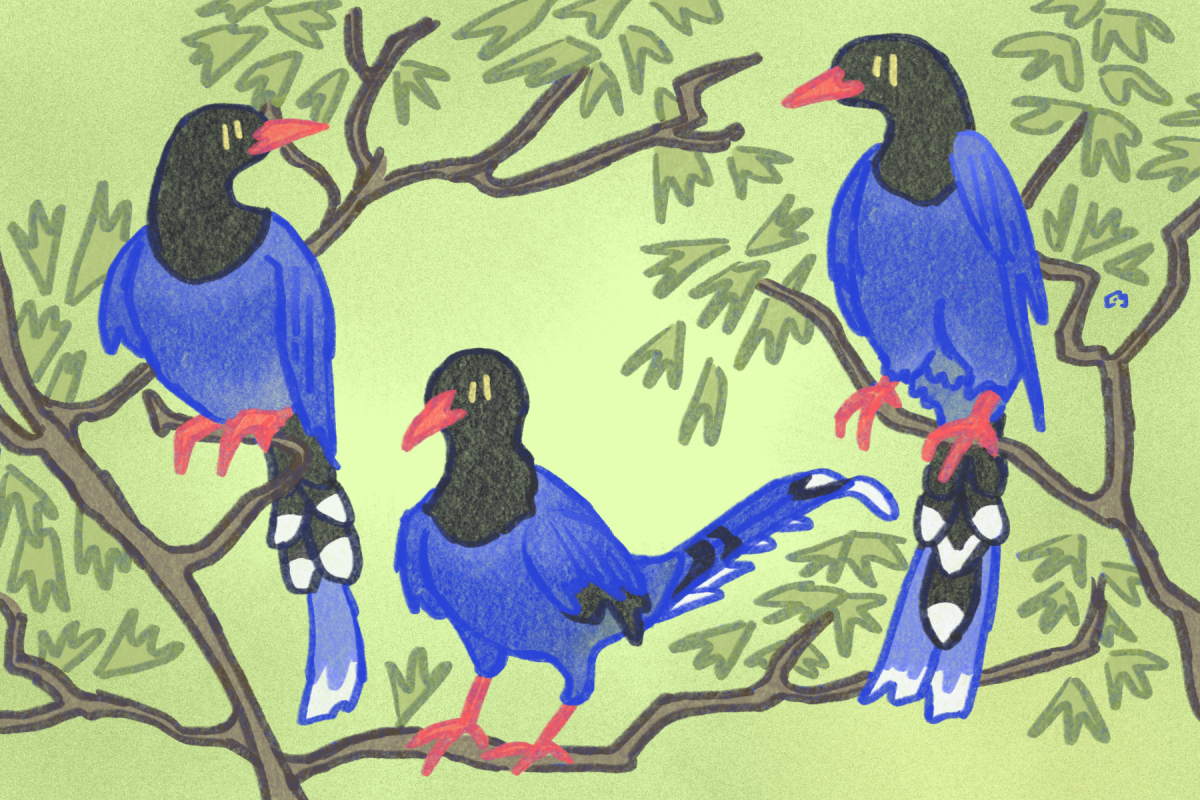























Amongst the banyan trees in the sub-tropical rainforests of Taiwan, a blue sparkle can be seen flashing through the brown and green shrubbery. The iridescent feathers of the Taiwan blue magpie (Urocissa caerulea) shine with bright shades of blue along the tail and wings, while the characteristically reddish-orange bill adds a vibrant touch of color to the scenery.
Many birds are well known for their extravagant plumage, from the elaborate mating displays put on by peacocks to the birds of paradise in New Guinea, and the Taiwan blue magpie is certainly no outlier. In a study published in the journal Nature, researchers in the UK found that the coloration of birds is correlated with the latitude in which they reside. Birds found closer to the equator within the tropical and subtropical regions were more likely to feature multiple colors and have more saturated hues. Accordingly, Taiwan is located in a tropical region, so brightly colored birds like the blue magpie are expected to reside here.
The vivid blue of the Taiwan blue magpie, however, may not actually be the true color of the bird. There are two types of color in the natural world: structural color and pigmentary color. When most people think of color, they are thinking of pigmentary color, where chemical molecules within an object called pigments reflect back a range of wavelengths that hits the eye. This explains why things like leaves appear green: as light waves hit the chlorophyll molecules found in leaves, the molecules reflect wavelengths of lights that are green. Structural color, or iridescence, differs from pigmentary color in the fact that there is no one molecule that is being excited. Rather, the light is interacting with a series of biological nanostructures that bend and refract the light to enter the eye at a certain wavelength. The resulting effect is that at different angles, different colors can be perceived by the eye. Consequently, one structure is capable of displaying a multitude of colors and creating an iridescent sheen. In the Taiwan blue magpie, the feathers are made of spongy medullary keratin, a protein that creates circular nanostructures that allow blue spectra light to pass through only at angles that are greater than 40 degrees. If the angle is less than 40 degrees, the breast feather coloration is hard to distinguish from the black head and neck feathers of the bird.
While the blue coloring of the main body is certainly important, given it inspired the name of the magpie, the bright orange bill and feet of the bird have also sparked cultural stories—making them just as worthy of recognition. According to Tsou (an indigenous Taiwanese tribe) mythology, the world once came under a great flood that pushed the people up into the high mountains. Without the warmth and comfort of their camp, the people asked animals to bring fire from the fire gods up to them. The Taiwanese blue magpie was the only animal able to bring back a flaming branch. But, in the process, the magpie burnt its beak and feet with bright red streaks. The cultural significance of the magpie led to its election in 2007 as the national bird of Taiwan.
The multi-colored beauty that is the Taiwan blue magpie has inspired generations of storytelling and scientific research. Although the Taiwan blue magpie is classified by the International Union of Conservation of Nature as a species of least concern for extinction, typhoons and earthquakes, along with human development, are impacting Taiwan’s high mountain ranges, leaving less habitat available for these birds to live in. To keep the magpie’s bright colored feathers flashing for future generations, more effort is needed to maintain the forest ecosystem where it resides. The survival of this Taiwanese cultural icon depends upon it.