




































































An octopus has the ability to vanish in the blink of an eye utilizing adaptive camouflage and skin texture. Now, Pennsylvania State University researchers have built a synthetic material that captures that idea. Their creation is capable of changing its appearance and shape in response to heat and other stimuli.
Published in Nature Communications in early 2026, the study was led by Hongtao Sun, an assistant professor of industrial and manufacturing engineering at Penn State, as well as researchers at the Georgia Institute of Technology. The researchers created a halftone-encoded 4D-printing technique that produces a soft hydrogel material known as “smart synthetic skin.” It can change its appearance for camouflage, and power soft robotic systems. The team described the method as 4D printing because it creates 3D objects that can adapt to changes in their environment over time.
To understand why this matters, it helps to look at the biology it is based on. Octopuses use specialized neuromuscular structures called chromatophores that expand and contract when triggered by signals from the nervous system in response to environmental changes. They also raise small skin structures called papillae, controlled by muscular structures called hydrostats, allowing them to quickly shift the texture of their skin. Together, these systems allow octopuses to alter their color, texture, and shape simultaneously.
The halftone printing method mirrors this same logic. Different regions of the hydrogel are programmed to shift between two states, similar to how chromatophores in octopus skin expand and contract. The Penn State team started by 3D-printing a hydrogel canvas. Using halftone-encoded printing, the researchers translate an image into a grid of microscopic regions whose density encodes light and dark areas, similar to how dots of ink create light and dark areas in newspaper photographs. Once converted, the image is then encoded directly into the hydrogel using controlled UV light during printing, leading to subtle differences being programmed into the material’s internal structure rather than adding ink or pigment.
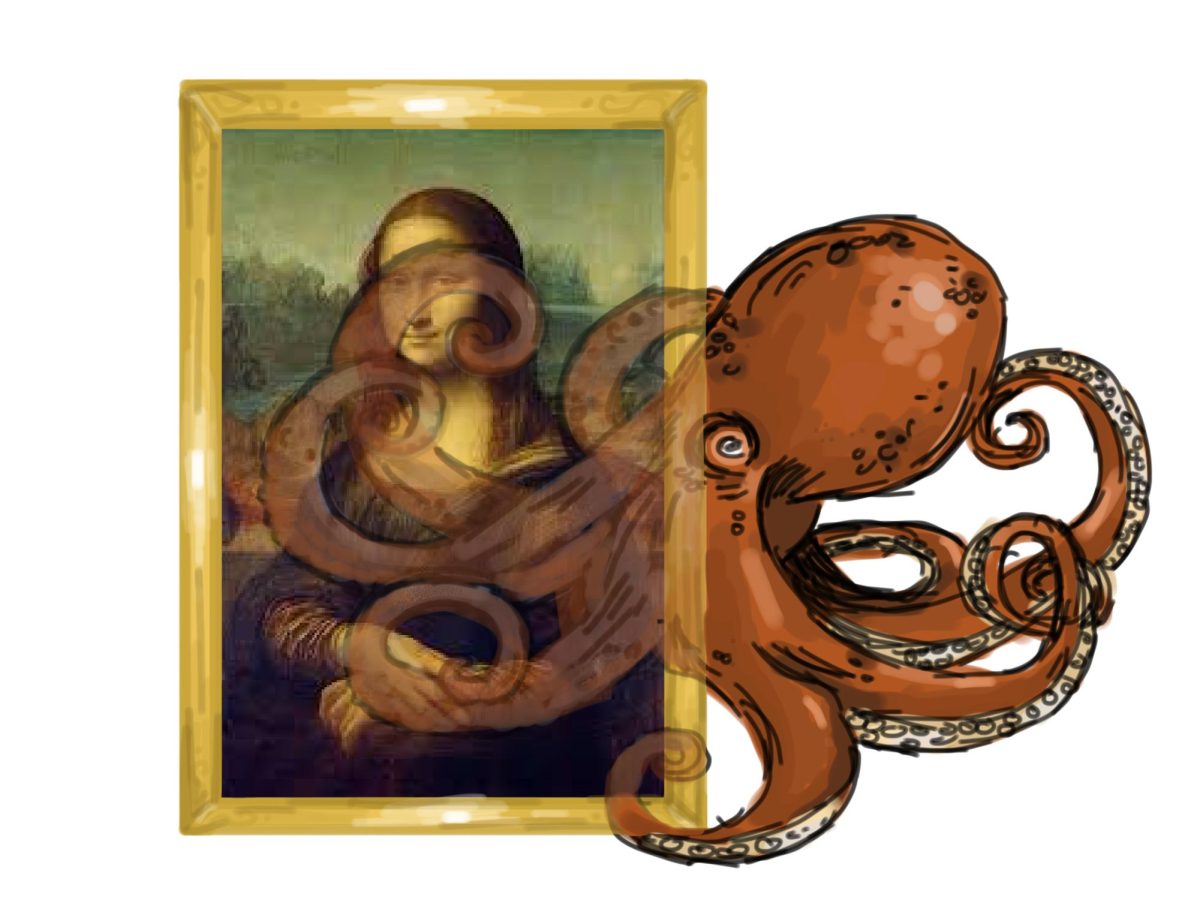
To put the technology to the test, the team encoded a photo of the Mona Lisa into the hydrogel film. When washed with ethanol, the image disappeared entirely. Dipped in ice water or gradually heated, the portrait slowly reappeared. This effect is reversible and repeatable. What makes this development unique is that a single material can coordinate visual changes, movement, texture adjustments, and shifts in shape all at once. Previous approaches often required stacking multiple materials or sacrificing one function to achieve another.
The potential uses of smart synthetic skin are vast. Researchers suggest that the material could be used in stimulus-responsive systems, biomimetic engineering, advanced encryption technologies, and biomedical devices. A surgical tool that adapts to body temperature, a camouflage surface that responds to its environment, or a wearable display that shifts shape all become more plausible with a single material that can do multiple things at once. However, the technology still has limitations: the material currently produces only grayscale images, functions best in wet or solvent-rich environments, and responds to stimuli relatively slowly.
Looking ahead, the team plans to develop a general and scalable platform that enables precise digital encoding of multiple functions into a single adaptive material system. Octopuses evolved to have adaptive skin long ago; and now, researchers are beginning to create similar abilities using engineered materials.

Abby • Mar 31, 2026 at 11:17 am
Thanks! Learned so much about octopuses today!
Issy • Mar 20, 2026 at 1:11 pm
Best article ever