



















































The ecological landscape of the San Francisco Bay Area consists mainly of marshes and estuaries, where salt water from the ocean collides with land to form acres of mud and reeds. At the ebb and flow of the tide, creatures from both sides meet and integrate to form a unique ecosystem that is the basis for an intricate web of organisms. These marshes are an exact gradient of salt water, fresh water from rivers and creeks, and nutrients from the soil. Even a slight change in any of these sources results in significant impacts to the pH, salt, and nitrogen content of the water, leading to disturbances that travel up the food chain and leave the unique organisms that live in these conditions struggling to survive.
When looking at the coastline of the Bay, however, the most noticeable feature is the brightly colored salt beds, which are made by people in order to harvest water that is high in salinity. They are known for their distinct bright colors, originating from the microorganisms that live in the water. Typically, one microorganism dominates each salt bed—since each pond is kept at one constant salinity level, the microorganism best suited for that environment will outcompete the rest. The areas dedicated to these salt ponds ultimately take away space from birds and other organisms that depend on that land for resources, exploiting them for commercial use and reducing the area’s biodiversity.
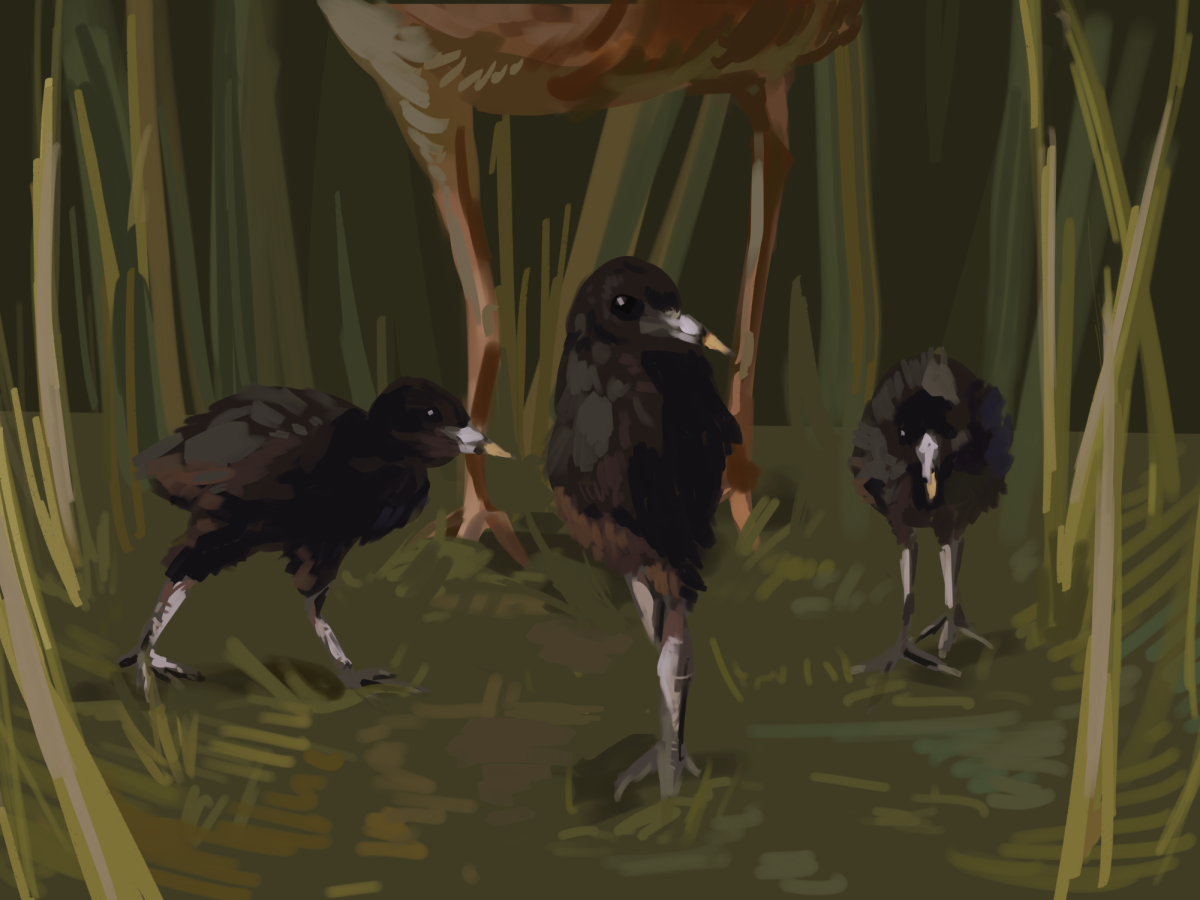
One of the most noticeable species affected by this is the Ridgway’s rail (Rallus obsoletus obsoletus). This subspecies is native only to the San Francisco Bay Area, with all 1100 birds within the species living there. These rails have a number of iconic qualities, including their signature “clack-clack” call. They mainly travel by walking or running, usually stalking among the reeds to forage for small fish and invertebrates. Rails also nest among the reeds, having adapted to use the invasive smooth cordgrass to provide nesting material and cover from predators. These nests protect their young, which are raised by both parents.
With so few numbers and the encroaching threat of further development and habitat loss, this species is classified as critically endangered. More threats include contaminants from manufacturing plants around the Bay, mostly the chemical methylmercury, which, once ingested by breeding parents, seeps into the eggs and lowers their viability. Less territory also results in inbreeding and the lack of genetic diversity.
Before they were restricted by habitat loss, Ridgway’s rails were originally known as “California clapper rails.” This is because they have similar genetic ancestors to light-footed clapper rails from San Diego and also seemed similar to clapper rails in Florida and the East Coast. However, further research revealed that the DNA sequencing between these birds showed a closer relationship between the West Coast rails, including rails in the highlands of Mexico, than their relatives on the Atlantic coast.
Ridgway’s rail, named after famed ornithologist Robert Ridgway (who was the first to identify the subspecies), has recently been further split into three separate sub-subspecies. The species in Colorado is named Rallus obsoletus yumanensis, the species in Southern California is Rallus obsoletus levipes, and the species in San Francisco is Rallus obsoletus obsoletus. The genus name Rallus indicates the bird is a rail, while the species name obsoletus is the result of its dreary coloring rendering it “dull.” A sad coincidence is that obsoletus sounds a lot like obsolete, and the most endangered of these rails is the San Francisco bird Rallus obsoletus obsoletus—the most obsoletus of them all.
Due to the challenges they face as a species, efforts are being made to stabilize the Ridgway’s rail population, mainly through habitat restoration. The salt company Cargill is donating land back to conservation groups and charities, leading to many new refuges. These programs and land stewardships work to bring back the marshes these birds populate and regenerate the healthy, biodiverse ecological environment of the San Francisco Bay Area.