

































































































It’s an idiom beloved by all: “I’ll clean my room when pigs fly!” The flight of this ordinary barnyard animal is often used to describe something implausible. But what about something that seems equally unlikely, such as when bumblebees breathe underwater?
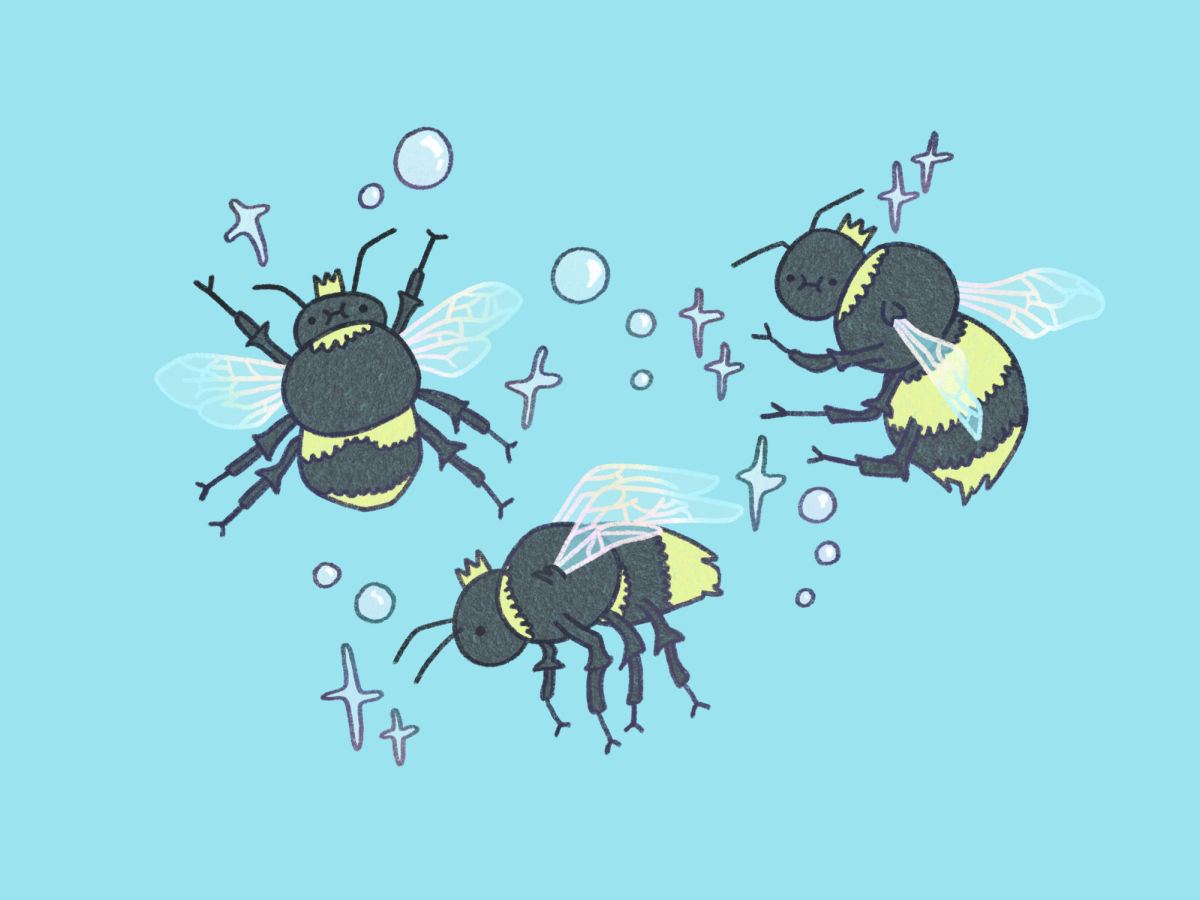
A study by Sabrina Rondeau, a biology researcher from the University of Ottawa, found that diapausing bumblebee queens can survive being submerged in water for a week. Diapause for bees is similar to hibernation for bears, as both creatures enter a state of extremely low metabolism. For queen bees, diapausing is an evolutionary tactic designed to help them survive winter. The queens of the bee species, Bombus impatiens, burrow into a dirt slope for overwintering (the method or process of surviving winter), even though this places them at risk of being drowned from winter rain. Due to this, the sole creators of colony workers evolved to survive a wet winter to prevent the extinction of their hive.
This discovery was actually an accident, as Rondeau had originally planned to test the effects of pesticides on bumblebees. Rondeau filled syringes with packed soil, placed the queens in the syringe, and shut them in a fridge to mimic winter conditions. However, upon a routine check, Rondeau actually found the tubes filled with condensation with the queens still alive.
To confirm this breakthrough, Rondeau designed an experiment. First, overwintering conditions were set up. Packed dirt near the needle of a syringe was the platform upon which the queens were placed. Then, flood conditions were simulated by controlling the level of water in the contraption. A control group had no water present in the tube. For other groups, high groundwater levels were simulated, leaving the bees to float on top of the flood. The last step was depressing the plunger onto the body of a queen to push it fully into the water, which kept the queens completely submerged. Rondeau placed these experiments into a dark fridge at four degrees Celsius for varying amounts of time. The queens were left for either eight hours, one day, or seven days. Surprisingly, the survival rate across all groups eight weeks post-experiment was 89.5%. Even more amazing was that “81% of the queens that were subjected to the most intense submersion regime and duration (i.e. maintained under water for seven days) were still alive after eight weeks of artificial overwintering, compared to 88% for the control group,” according to Rondeau’s study. But Rondeau was not satisfied with just the confirmation of underwater survival. How exactly did the insects do it?
After two years of extensive research, Rondeau finally concluded how the bumblebees manage being underwater for so long: they survive using underwater respiration and anaerobic metabolism. The researchers know this because they “detected low but consistent CO2 production during submersion, persisting through four and eight days under water,” according to a later study by Rondeau. A key component of any form of respiration is the intake of oxygen and output of carbon dioxide, or CO2. This evidence was backed up by the fact that “underwater gas exchange, measured from CO2 levels in the headspace of a respirometry chamber, was supported by a decline in dissolved oxygen in the water.” Clearly, the queen bees were using dissolved oxygen in the water to breathe, as evidenced by the decline in its amount.
But of course, underwater respiration was not the only reason why the queens could survive for so long. Rondeau’s study found that “submerged bees also accumulated lactate as an anaerobic end-product during submersion, which decreased to pre-submersion levels after a week of recovery.” Anaerobic respiration is a type of cellular respiration, which is characterized by the production of adenosine triphosphate (the essential energy molecule) without requiring oxygen. It is also known for producing a byproduct called lactic acid due to its energy-efficient method. In order to break down lactic acid, an enzyme known as lactate is necessary. So the accumulation of lactate, especially in such abundance, points to anaerobic respiration.
However, why did the bees choose not to use the oxygen they were inhaling physically? To answer this question, it was found that the bees’ “metabolic rate decreases by more than 95%.” Now this makes sense: in order to preserve energy, the queens slow down their metabolism and use a lower-energy cellular respiration.
This study is imperative, since the effects of climate change are only getting drastically worse. Extreme conditions like flooding affect all living organisms, from the small but mighty queen bee to the human trying to get home. Prolonged flooding can seriously reduce the amount of queens available to establish colonies. Understanding how they survive in dangerous conditions will not only help protect diapausing queens from extreme weather, but also lead to further understanding of the impact of diapause disruptions on bees.
Rondeau’s research also serves as a reminder of how little humans truly know about the animal kingdom. The fact that humans’ backyard friends have been quietly breathing underwater and no one knew a thing for the past millenniums speaks to how much humans can learn from nature. Perhaps the answers we seek are in the overlooked, but hard at work, bees.