




























































In most cultures, the word “kiwi” typically evokes thoughts of a round, brown fruit that is commonly found in supermarkets. In a military setting, the word “kiwi” refers to Air Force personnel completing groundwork. In New Zealand, some people also call themselves “kiwis.” At first, these three definitions appear to have wildly different meanings. However, one definition unites them all: the very origin of the word, which comes from the kiwi bird.
Native to New Zealand, the kiwi bird got its name from the Māori people—indigenous Polynesian people of New Zealand—who attempted to mimic the unique high pitch chirping calls of the male birds. The bird lives in the forested islands of New Zealand, spending its days digging nesting-burrows and foraging for food. The diet of the kiwi mostly consists of worms and insects, but they have also been found to eat berries and seeds. As mentioned before, since the kiwi can only be found in New Zealand, some New Zealanders have taken a special pride in the bird, and thus refer to themselves as “kiwis.” However, it’s important to note that the term “kiwi” is contentious and has been considered offensive by some groups of Māori people.
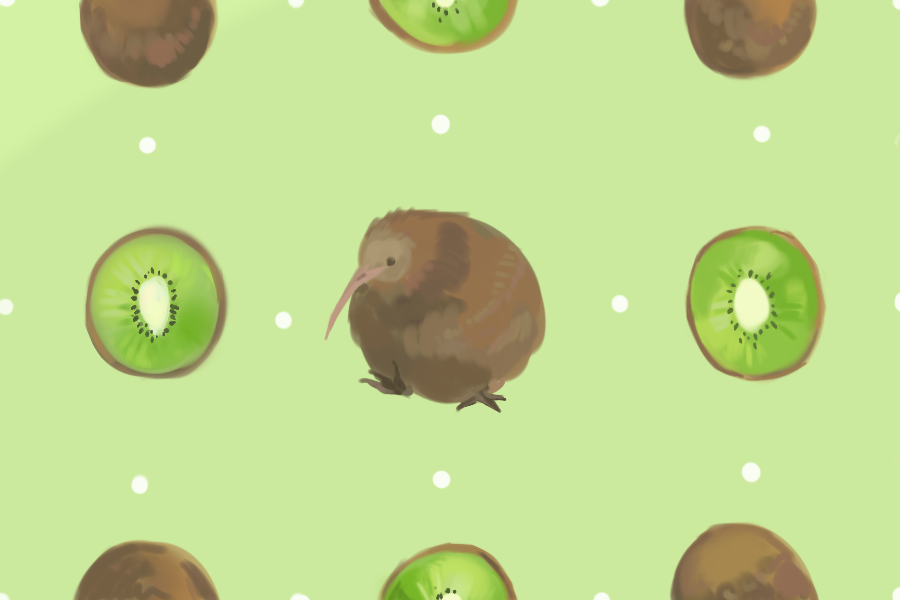
In 1904, farmers discovered how well the Chinese gooseberry could grow within New Zealand. These farmers thought that the furry brown outer shell of the fruit resembled the kiwi bird, with its coloration and round body. From this, the name was born.
Due to the fact that the kiwi bird only lives on the island of New Zealand, where it has few natural predators, the kiwi has evolved into a flightless, round bird with wings only about an inch long that are almost completely hidden by feathers. To compensate for this, the bird has abnormally strong legs, which it uses to kick up debris in order to access the grubs underneath. Unlike most birds, the kiwi’s nostrils are actually on its bill, allowing it to poke into logs and sniff out what is inside. When it senses danger, the kiwi runs away with its bill in the air to better detect the predator through smell. However, due to its unusual anatomy and limited usage of its wings, the kiwi can’t always get away from the predator in time. With the introduction of dogs, stoats, and other invasive species from Europe, the kiwi faces a lot more danger from new predators in comparison to the zero natural predators that evolution prepared it for. Kiwi populations have declined rapidly as a result, with 95% of chicks killed by these predators, who can easily find and capture the young birds.
To combat this, the New Zealand government has tried to protect this national symbol with the plan Predator Free New Zealand, an ambitious initiative to eliminate invasive species by trapping and poisoning stoats, cats, rats, and dogs. This unique method has resulted in questions about the ethical value of this process, since killing a huge population of invasive mammals is no easy task. Many trappers use poisons such as anticoagulant brodifacoum that affect any mammal that eats out of the bait, resulting in off-target deaths of non-invasive species that have the potential to disrupt the ecosystem. New technologies and more selective poisons are necessary to make sure this strategy for predator management is completed effectively. Yet, despite how outrageous Predator Free New Zealand sounds, it has been accomplished successfully, though on a small scale.
Another plan to repopulate the kiwi is Operation Nest Egg, a program where kiwi fledglings and eggs are taken from nests in already stable populations to be raised in a nursery. These birds are cared for in a captive rearing facility until they are a few weeks old, then transferred to a predator free, fenced-in zone. After they have been deemed ready for release, they are either released back to their original population or transferred somewhere else entirely to begin their own colony.
So far, despite government and conservation efforts, these two programs have had limited success. Researchers have found that some wild-caught and captive birds raised fully in captivity have had more success in the wild than the birds from Operation Nest Egg. However, the outcomes of relocations are rarely published. This leads to a lack of knowledge on how stable populations of relocated birds are and whether their return actually has any ecological benefits. Researchers found that, especially in non-predator free zones, releasing the birds may simply be feeding the resident invasive predator population—not actually creating a new colony and repopulating the area. They also found that Predator Free New Zealand has not yet prevented bird deaths. Despite decades of conservation efforts, one fourth of New Zealand native bird species have still gone extinct.
The kiwi bird represents an interesting problem in conservation, where millions of animals must be killed in order for another group of species to survive. While efforts to preserve the bird and other native New Zealand species have persisted over the years, the programs still have many flaws, and more support and efficiency is needed to allow for a smoother transition back to original population sizes. Continued research, the dissemination of the knowledge gained, new technologies, and popular support are needed to reverse the decrease in populations to successfully bring back the ecological balance of New Zealand. If this program is successful, it will become a model to other efforts around the world, and they can use this “New Zealand experiment” as an example of how successfully removing a nonnative species can allow for native species to prosper.