


































If you were to observe some of the early sketches of flying machines by Leonardo Da Vinci and the Wright Brothers, you would find more than just nuts and bolts. An integral part of the eventual development of modes of human flight were countless diagrams of bird anatomy and behavior. These illustrations provided a basis upon which engineers could understand and mimic the natural abilities of winged creatures.
Biomimicry is defined as the design and production of materials, structures, and systems that are modeled on biological entities and processes, and it has contributed to the development and improvement of countless things. Yet, we often don’t give enough credit where credit is due. The scientific community has a tendency to get wrapped up in the mechanization of the future, so much so that it forgets to consider the past and the everyday phenomena that we have only begun to understand. This article will focus on one particular instance of biomimicry that is so ubiquitous in today’s world that it may be surprising to hear that a plant did it first: Velcro.
George de Mestral was born on June 19, 1907 in a small village near Lausanne, Switzerland. He began to show intellectual promise in childhood, patenting a toy airplane at age twelve. In 1930, he graduated with a degree in electrical engineering from the Ecole Polytechnique Federale de Lausanne and went on to work in a Swiss machine shop. One of his favorite pastimes was hunting, and in 1941 he went on a hunting trip with his dog, an Irish Pointer, in the Alpine Countryside. Upon returning from a hike through the woods, de Mestral attempted to brush off the burrs from burdock plants that had attached themselves to his pants and his dog’s coat. After noticing the difficulty of this task, he became curious and decided to observe a burr under a microscope.
Burdock is a versatile plant and a member of the sunflower botanical family (Asteraceae). It is a traditional medicinal herb valued for its anti-inflammatory, antioxidant, and antibacterial properties, as well as a common ingredient in root beer recipes. Burdock burrs are small, rounded seed pods displaying hooked tip bracts.
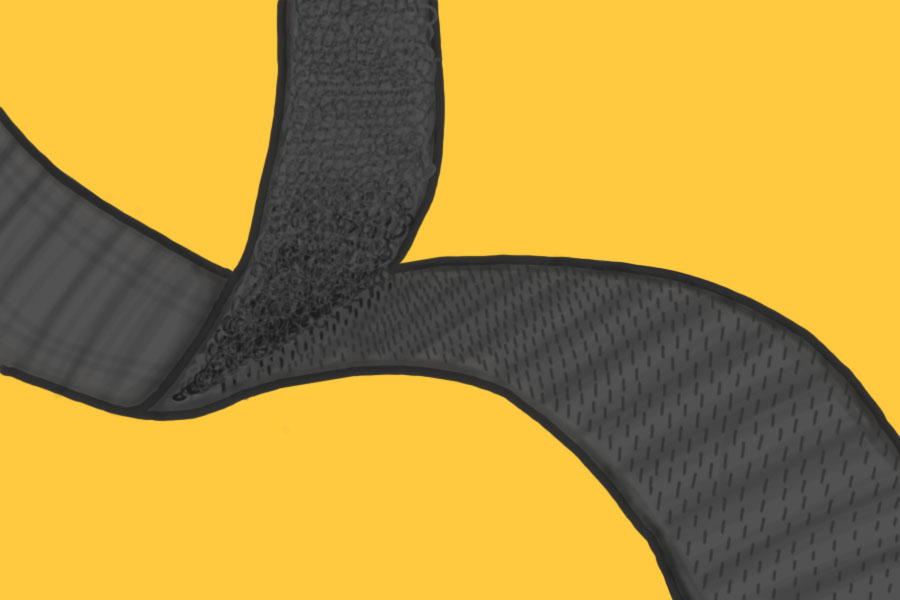
Through his examinations, de Mestral determined yet another use for an already multifaceted organism. In 1955, after nearly a decade of research, he finalized and patented his product known as Velcro. The name Velcro is a combination of the French words velours (velvet) and crochet (hook). Velcro’s design features thousands of tiny hooks combined with a separate strip of thousands of fabric loops for the hooks to catch, resulting in a secure and reliable fastening system. Initially, de Mestral used cotton to manufacture his product, but later worked with a fabric company in Lyons, France to create hooks made of nylon which provided the perfect balance of flexibility and firmness and also did not wear with use. Eventually, he founded his own company to manufacture this new product.
Velcro’s take off can be largely attributed to NASA and the Apollo program of the 1960s, as the astronauts used it to secure items they didn’t want floating away in the spacecraft while in orbit. Prior to this, in 1959, the New York City’s Waldorf-Astoria Hotel conducted a fashion show complete with Velcro diapers and Velcro golf jackets. In 1968, Puma introduced a sneaker with Velcro fasteners, the first major shoe company to do so and thus set off a domino effect influencing Adidas, Reebok, and many more brands.
However, on April 2, 1978, Velcro’s original patent expired and became a metonymy associated with hook-and-loop fastening products—as Kleenex is associated with tissues. Perhaps one of the most interesting things about Velcro is that it has only grown in its contributions to new innovations as its versatility, much like the plant that inspired it, appears to evolve to no end. It wasn’t until 1991 that toy companies developed the Velcro ball and mitt set, and only recently has it been fastened on the back of iPads so that they can be mounted onto walls and other surfaces.
So the next time you have to take your dog for a walk or just need a breath of fresh air, stop and take the time to observe the nature around you. While we often consider the universe to be full of the inexplicable, there is reason to believe that an adept inquisitiveness and perhaps a little bit of luck will serve as the foundation to unlock some of its inner mystery in order to better understand and construct our future.