









































































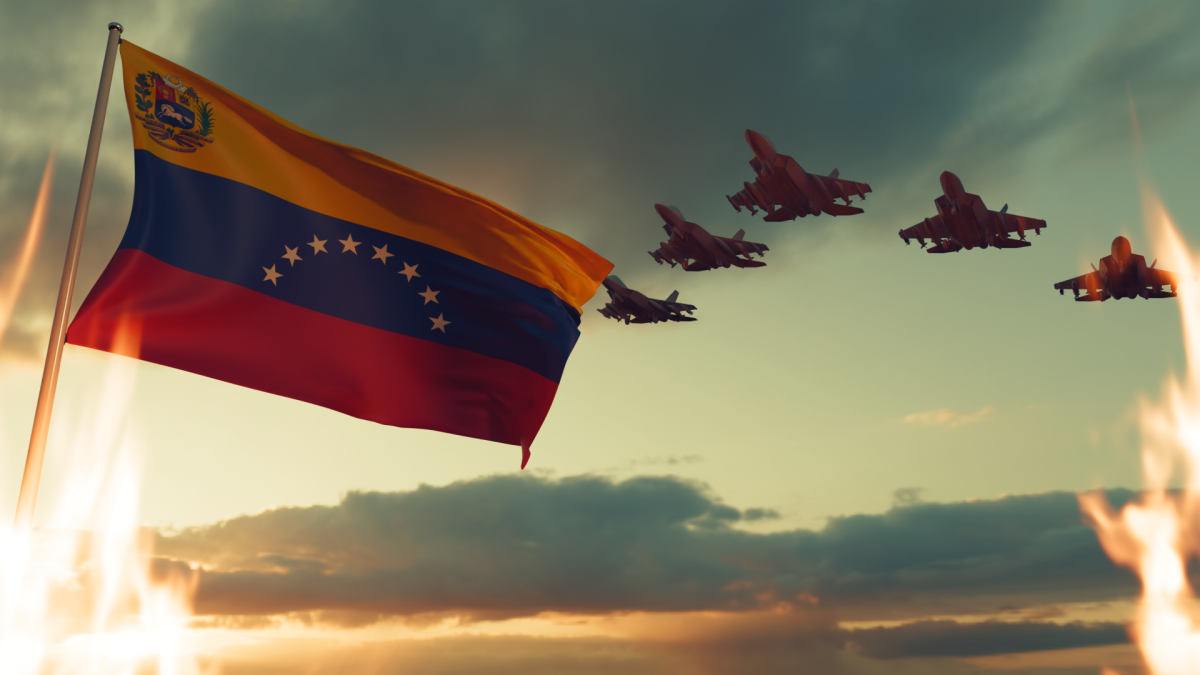
The United States just abducted Venezuelan president Nicolás Maduro. There are essentially two stances being represented in the national media, both of which are informed by not-so-subtle partisan undertones. The first stance, being peddled by left-leaning news sources, is that this was an illegal military operation enacted without authorization from Congress that violated numerous international laws. From this perspective, this is a move that does nothing to protect US interests, needlessly jeopardizes international peace, and does little to establish lasting democratic leadership in Venezuela.
Running counter to this narrative is the position of more conservative news outlets. These sources maintain that Maduro was unlawfully elected and was trafficking narcotics, and therefore deserved to be ousted. Additionally, US presence in Venezuela would allow them to dictate what is done with Venezuelan oil. This could potentially allow them to fund their occupation or secure further economic advantage and end the Venezuelan practice of selling oil to China and other US rivals while still refusing to sell to the US.
This issue calls for something sorely lacking in the modern political media landscape: a tolerance for dichotomy. Multiple things can be true. From the progressive perspective, this operation does indeed jeopardize international peace, and it does in fact violate international law. This is supported by the reactions of foreign politicians as well as law professionals. Spanish Prime Minister Pedro Sánchez said, “Spain did not recognize the Maduro regime. But neither will it recognize an intervention that violates international law and pushes the region toward a horizon of uncertainty and belligerence.” Russia and China echoed this sentiment, with each of them “strongly condemning” the maneuver in separate statements. UN Secretary-General António Guterres released a statement by way of his spokesperson saying that “These developments constitute a dangerous precedent. The Secretary-General continues to emphasize the importance of full respect of international law, including the UN Charter. He’s deeply concerned that the rules of international law have not been respected.”
To be fair, the conservative narrator has empirical fact on its side too. As Sánchez alluded to, Maduro was not lawfully elected. According to Resultados con Venezuela, a website that compiled voting data composed of both information released by the opposition party and publicly available polling results, Edmundo González won in a landslide, earning 67% of the vote. So how did Maduro maintain power? Well, the Consejo Nacional Electoral (CNE) declared Maduro the winner with a slim 51.2% majority. So, somebody is lying, or at least looking at very different data. In determining which of these sources has greater validity, it’s important to consider any biases or conflicts of interest that either platform might hold. A relevant fact in this case would be that the CNE is run by government-appointed officials who were appointed by and beholden to Maduro. These elements of the prevailing narratives are backed by empirical fact and are not in contradiction of each other. It can be true both that Maduro was corrupt and that the action taken to remove him was illegal. The more complicated aspect of this issue is where the two narratives disagree, namely as to what is going to be done and what should be done by US forces in Venezuela. To understand what the current administration’s motivations were in staging this abduction is a crucial step in understanding the trajectory of US action in Venezuela. Across both parties there is a shared sentiment that the US should stand as a beacon of democratic values for the rest of the world.
Now whether that responsibility necessitates intervention in foreign countries is up to personal opinion, but while that has been a piece of the administration’s justification, a far more common defense has been to point to Venezuelan oil, and the potential for control of that resource. Whether continued investment in and reliance on oil is beneficial for the environment is an entirely different politically divisive conversation, but it is undeniable that it would be a huge aid economically.
The question remains, however: is control of Venezuelan oil attainable? The short answer is no. Venezuela’s oil reserves are managed by the Venezuelan state, and while there is a limited level of Venezuelan government at the moment, that is not a set of circumstances that will likely be allowed to continue. Despite comments from president Trump claiming that the US will “run Venezuela,” they will not be allowed to administer a foreign country for much longer than the time required to choose a new democratically elected leader. That would change the issue from a targeted action to remove an autocratic ruler to an invasion, occupation, and attempted conquest of Venezuela. The UN would not allow this, not to mention Venezuela’s allies, among which are China and Russia, two of the most powerful rivals to the US.
Despite the repeated talk of annexation of foreign territory coming out of the executive branch, it is hard to imagine the rest of the government would allow a maneuver so potentially damaging to international peace. So while ideally the US seizes control of Venezuelan oil and profits from its occupation of Venezuela, this is largely a pipe dream. This leaves us right back where we began, evaluating the consequences of this action solely as an attempt to depose a dictator. Was ousting Maduro morally defensible? Yes, definitely. Did it jeopardize international peace? Yes, definitely. But in the US centric national media, the most important perspective seems to have been overlooked: the feelings of the Venezuelan citizens themselves. Venezuelans seemed to be overwhelmingly in favor of the removal of Maduro, a perception supported not only by polling numbers, but also by the Venezuelans who were celebrating Maduro’s capture in the streets. However, 86% of Venezuelans oppose military occupation according to a poll from Hinterlaces. So how should we view the abduction of Nicolás Maduro? As in every complex political issue, there are positives, negatives, and copious amounts of gray area. It isn’t as flawless as Republicans would tell you, and it isn’t as reprehensible as Democrats would suggest. But despite my discouragement of partisanship, the two sides are not equally valid. Yes, Maduro was a dictator, and yes, it was likely in the best interest of democracy and the Venezuelan people that he was deposed, but the precedent this sets in international relations far outweighs those benefits. This action sets the precedent that it is acceptable to violate international law to kidnap the ruler of a foreign power, a precedent that if allowed without consequence will damage government stability and security for generations. This is the real legacy of the US operation in Venezuela.