









































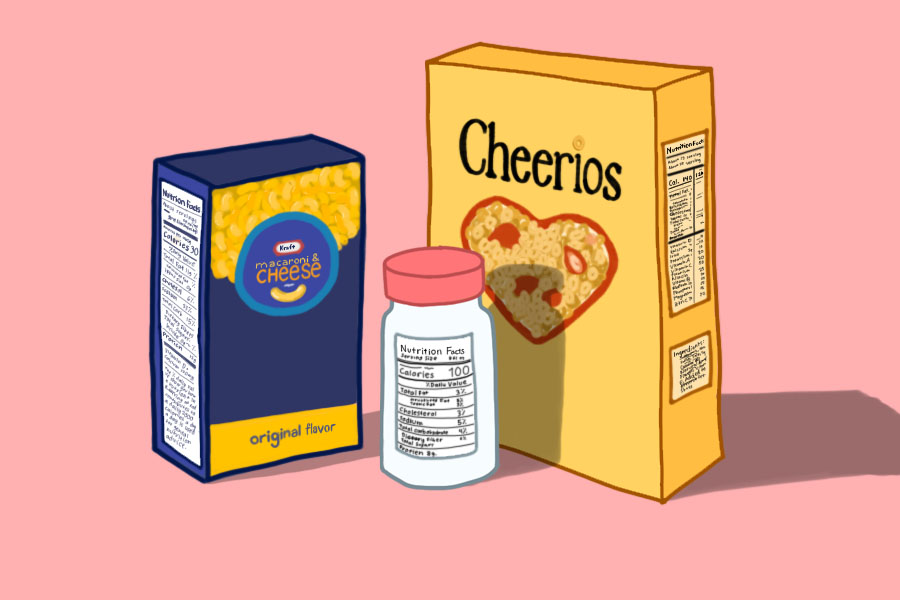



























If you are like me, and you pick up a box of packaged food and glance at the nutrition label for 15 seconds as though you understand what you’re about to put in your cart—know that you are not alone. In fact, the majority of people in the United States either don’t read nutrition labels at all or only glance at them briefly. However, as someone who is soon to be completely fending for herself nutritionally, I’ve realized that it’s time to intentionally slow down and learn to read this cryptic information. The following guide is meant to help you understand the basics of nutrition labels without feeling too overwhelmed, but please note that it is not intended as health advice. The information here is based on the FDA’s regulations about what must legally appear on a label. As you learn how to read the label, you’ll hopefully realize that its existence is a balancing act between profit, legal requirements, and the ways our own ignorance can be taken advantage of.
At the top of the label, below “Nutrition Facts” and before the first thick black line, you’ll see the servings per container and serving size. This is very important. The serving size reflects the average amount people typically eat, but it is not meant to be a recommendation for how much you should be eating. Everything else on the label is based on this number, which is why it matters so much. Because of this, smaller serving sizes can make foods appear healthier than they actually are (something companies often take advantage of). If you eat more than one serving, then all the numbers listed below need to be multiplied accordingly.
Directly below the serving size, you’ll find a calorie number, followed by a long list of nutrients. The first group of nutrients includes fat, cholesterol, sodium, carbohydrates, and protein. Carbohydrates, fat, and protein are macronutrients, meaning we need them in larger amounts since they provide energy. Cholesterol and sodium are also listed here because they are important nutrients to monitor. But, make sure you don’t overconsume them.
Next, a bold line separates these nutrients from micronutrients—vitamins and minerals like vitamin D, calcium, iron, and potassium. Micronutrients do not provide energy, but they are essential for things like bone health, oxygen transport, and muscle and nerve function. These four micronutrients are required by the FDA to be listed on nutrition labels because they are especially important nutrients that many Americans tend to underconsume.
Next to most nutrients on the label, you’ll see percentages called Percent Daily Values (%DV). The Percent Daily Value shows how much one serving of a food contributes to the recommended daily amount of a nutrient, using a 2000-calorie diet as a reference. However, this does not mean you are being told to eat exactly 2000 calories a day.
Nearby you’ll find the ingredients list, the last part of the nutrition label. Ingredients are listed in descending order by weight, meaning the first few ingredients tell you what the food is mostly made of. This is something many people skip over, but it’s really important. Even just looking at the first three ingredients can tell you a lot about what you’re actually eating, since they make up most of the product. That said, the list doesn’t always go into detail. For example, it may say “natural flavors” without explaining where those come from; they could be from enzymes extracted from animals and still be considered natural according to the FDA.
You might be wondering about all those nutrition claims on the front of the package—the ones that say “fat free,” “reduced sugar,” “calorie free,” etc. These are marketing-influenced nutrition claims, which are still regulated by the FDA and must meet certain requirements to use. However, they are also designed to make you feel like it is not necessary to read the full Nutrition Facts. Many of these claims are highlighted to make the product seem healthier, even though they only reflect one part of the food.
If it seems like reading the nutrition label leaves you even more confused at first, don’t worry. Knowing what and where things are is the first step, and it allows you to keep building your understanding from there. Companies often tread the line between making money and being transparent about what their food contains. But with this knowledge, you can keep yourself informed and better understand what you’re choosing to drop into your cart.