














































































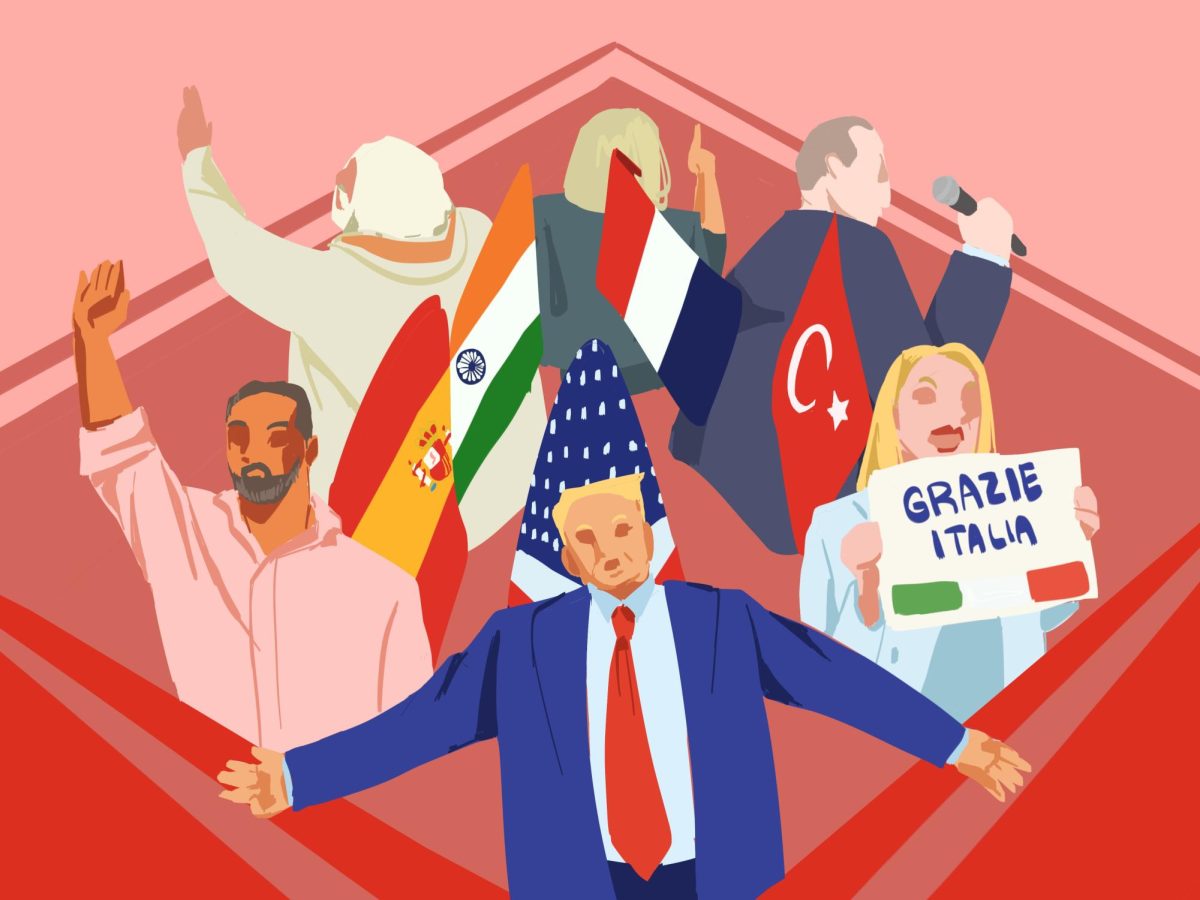
On November 4, standing on a stage surrounded by towering American flags topped by golden eagles, Donald Trump, flanked by his family and ultra-rich donors, announced his victory over Kamala Harris, the vice president and Democratic candidate for the presidency. Just months before, Marine Le Pen, surrounded by energetic supporters, celebrated her party’s rise to prominence in the French legislature. Two years before that, Giorgia Meloni held up a poster with the words “Grazie Italy” emblazoned upon it as she joyfully declared her victory in becoming prime minister.
There is one major unifying factor between these three moments, aside from their dramatic electoral victories: all three leaders are major right-wing populist icons. Trump is a former business tycoon who rode anti-immigrant and isolationist sentiment to the White House. Le Pen is the heir to a political dynasty whose National Rally traces ideological roots to far-right postwar movements and Meloni is a leader who began in a neo-fascist youth movement and has been an outspoken proponent of Islamophobia and ultraconservatism. They were all once considered fringe figures, yet each ultimately gained prominent positions in their governments.
But this isn’t just a Western sensation. Since 2014, Narendra Modi has led India as prime minister with a momentum of Hindu nationalism and social conservatism, causing major democratic backsliding in the world’s largest democracy. Recep Tayyip Erdoğan assumed the role of president of Türkiye in 2014, and has since promoted authoritarian and protectionist policies.
Each right-wing populist’s rise is unique in its own way. Some revolve around personality cults, such as those of Trump and Modi, while others are based on nationalist tendencies. However, this new era of right-wing nationalism, a dramatic shift from liberal globalist democracies, seems to be a reaction against the latter. Despite large successes and progress that characterized these progressive governments, many voters felt threatened by the loss of national identity in favor of global harmony. This gave birth to modern right-wing populism, which played on these often irrational fears and mixed them with anti-minority sentiment and distrust in institutions.
Right-wing populism is starting to rear its ugly head in many nations that still embrace liberal democracy: Reform UK, which led the infamous Brexit; Alternative for Germany, which fearmongers against refugees while slowly gaining prominence; and the Party for Freedom in the Netherlands, which advocates banning the Quran and promotes Euroscepticism. Even as current mainstream parties rally against these unwelcome incomers, these groups have started gaining numerous seats in legislative bodies.
However, some nations have been able to effectively counteract this growing movement. In Spain, Vox, a political party that gained momentum in the late 2010s, started slowly losing support after voters became disillusioned with the extremist messages, shifting Vox voters to support the dominant centrist parties. Even in France, against a rising tide of right-wing populism, a plethora of parties ranging from the far-left to the center-right have come together to create a coalition government. Right-wing populism may be a reaction against liberal globalism, but liberal globalism does not need to become a reaction against this right-wing populism. Instead, a focus on unity, nonpartisanship, and fact-based leadership can help mitigate the rise of conservative populism and allow the governments that have shaped the modern world to endure.