


































































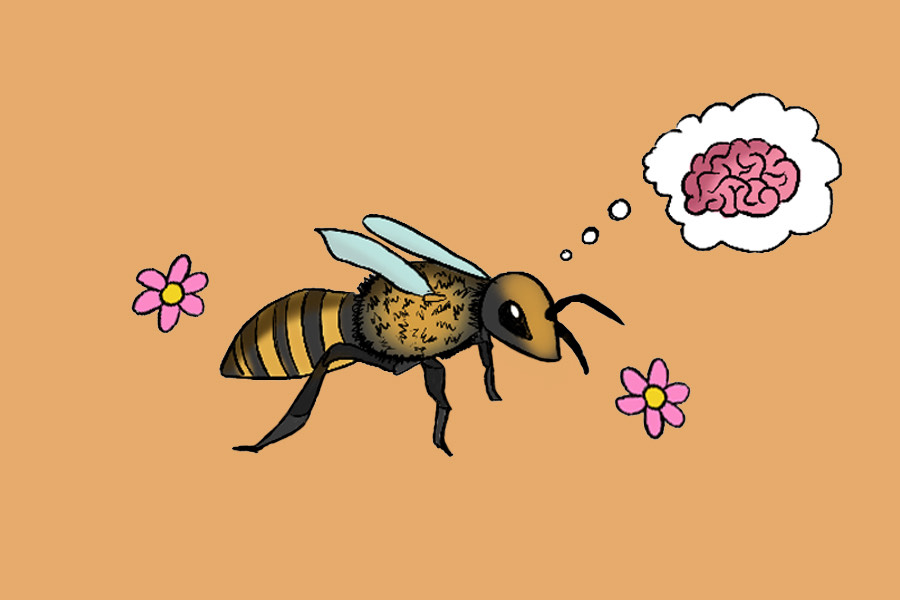
While a bee’s brain is only the size of a sesame seed, it has proved to be the epitome of the idiom “small but mighty” due to its simple yet effective visual processing system. Scientists have long known that bees have a sophisticated visual pattern learning ability, using scanning shortcuts thanks to their ability to differentiate between faces and flowers in their surroundings. However, the question of how they are able to do this has been unclear, until recently.
In a study of the cognitive abilities of bees, researchers at the University of Sheffield built a computational model of a bee’s brain, and they found that a bee’s pattern recognition is dependent on its movement relative to its surroundings. A surprising result of this research is that, despite its small size, a bee’s brain is shockingly accurate and efficient at learning from visual patterns. This proves that the learning ability of an animal depends on its inner neural computations, not the size of its brain, according to Lars Chittka, Professor of Sensory and Behavioural Ecology at Queen Mary University of London.
In a previous collaborative research study between University of Sheffield and Queen Mary University, researchers found that bees use active vision to process information, which means that they collect and process information through their movement in flight. The most recent study by the University of Sheffield, published by eLife journal, reveals that bees have optimized neural circuits based on their interactions with their surroundings. The result is that bees use significantly fewer neural signals to accurately recognize complex visual patterns, and this use of shortcuts reduces the energy required for learning.
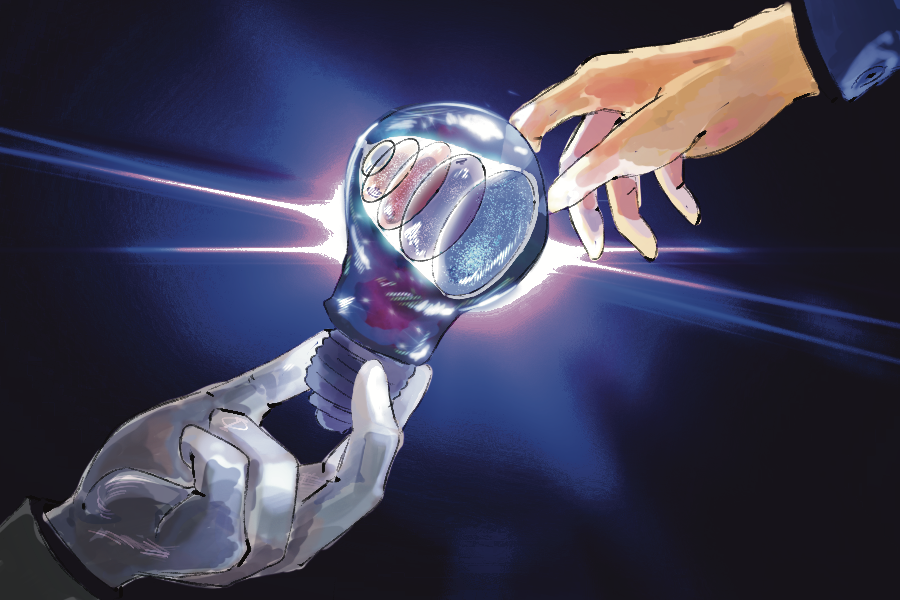
These findings have a lot of significance for the field of biology, as they provide greater insight into the accuracy of animals’ cognitive patterns and their independence from size, but it also has remarkable implications for the future generations of AI. Currently, AI is trained to recognize objects in its environment through different types of learning processes, or models, such as supervised learning, unsupervised learning, and reinforcement learning. However, all of these models require massive amounts of computing and data processing power.
With the newest discovery of the mechanisms in bees’ brains, which use shortcuts to recognize complex patterns while in motion, the researchers at the University of Sheffield think that a learning model based on this process can make AI more energy and time efficient. Even with their computational model, they saw that it took far fewer neurons to learn complex patterns because of its behaviorally driven learning.
“Our new model extends this principle to higher-order visual processing in bees, revealing how behaviourally driven scanning creates compressed, learnable neural codes. Together, these findings support a unified framework where perception, action and brain dynamics co-evolve to solve complex visual tasks with minimal resources—offering powerful insights for both biology and AI,” said Professor Mikko Juusola, Professor in System Neuroscience from the University of Sheffield’s School of Biosciences and Neuroscience Institute. Thanks to the insight and advancements from bee brains, the future of AI looks bright indeed.