Emma Lee (’27)
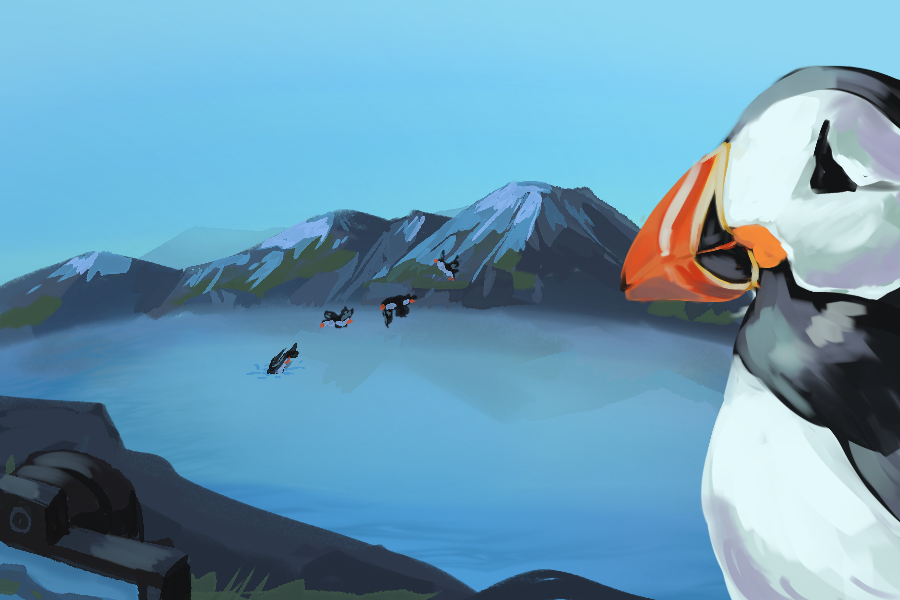
An Atlantic Puffin watches as other puffins are photographed by a camera.
Over the winter break, many malls and businesses had elaborate decorations for the Christmas season. From Christmas trees to signs pointing to the North Pole, anything snow-themed was put on display, including, interestingly, penguins. However, penguins are not found in the North Pole, with only the Galapagos Penguins being anywhere above the equator. The penguins’ forgotten relatives, the puffins, who actually live in the North Pole, are nowhere to be seen on display.
Despite the abundance of puffins in the Northern Hemisphere, very little is known about these “flying penguins.” Studies on puffins are limited, and impacts of melting sea ice and global warming on their populations are hard to measure, requiring decades of careful observations in subzero temperatures along treacherous cliff faces.
The Atlantic Puffin (Fratercula artica) is the most common of the puffin family, which also includes Tufted Puffins and Horned Puffins. The Atlantic Puffin lives in the Northern Hemisphere, occupying a wide range that reaches as far down as North Carolina. Atlantic Puffins are around the size of a crow, and their plumage has a unique black and white pattern. They have an orange-red bill that gives them the nickname “clown of the sea.” Their call sounds like a quack or a croak, with rising and falling pitches. Puffins swim by using their wings to flap underwater, contrary to penguins, who only use their flippers to steer. They can also fly and catch fish by diving into the water and chasing down their prey, diving up to 200 feet in search of small fish such as herrings.
The puffin is a seabird, preferring to remain in the open sea during adulthood and coming closer to coasts to join colonies for breeding. Their nests are typically in burrows among rocks that are three to seven feet long. They lay one egg per nest, which hatches after a forty day incubation period. At first, both parents feed the nestling by directly giving it fish through regurgitation. Eventually, the parents just drop the fish on the floor for the nestling to eat. The fledging is ready to leave around 44 days after hatching, and immediately heads out to sea.
One study published in 2021 presents a new way to track the behavior of animal colonies, using puffins as a model species. Using GPS tracking of ringed birds, analysis of fecal samples, and motion capture cameras, researchers spent a year tracking the movement of four breeding colonies: Wales, Norway, Northern Iceland, and Southern Iceland. They found that Norway and Southern Iceland had declining populations, which is consistent with previous literature given that Wales and Northern Iceland have more established colonies. Using GPS tracking, they found that the puffins in the areas with declining populations were foraging farther and longer than their counterparts in established areas. This is interesting, as typically a more populated colony would have its members foraging farther due to the competition for fish. However, as temperatures rise and fish migrate toward cooler waters, certain areas near warmer currents are experiencing a decline in fish populations, and thus puffins must travel farther to catch fish.
Notably, this study was conducted in only one year, rather than the typical decades needed for a study of this magnitude. By analyzing multiple colonies, researchers could test multiple factors to see how the puffins respond in different conditions, without having had to wait until an area degrades into that condition. This makes research faster and more recent, allowing us to evaluate the effect of current and potential future colony conditions without a long history of observations that may or may not exist depending on the species.