Photos Courtesy of SFHS Archives
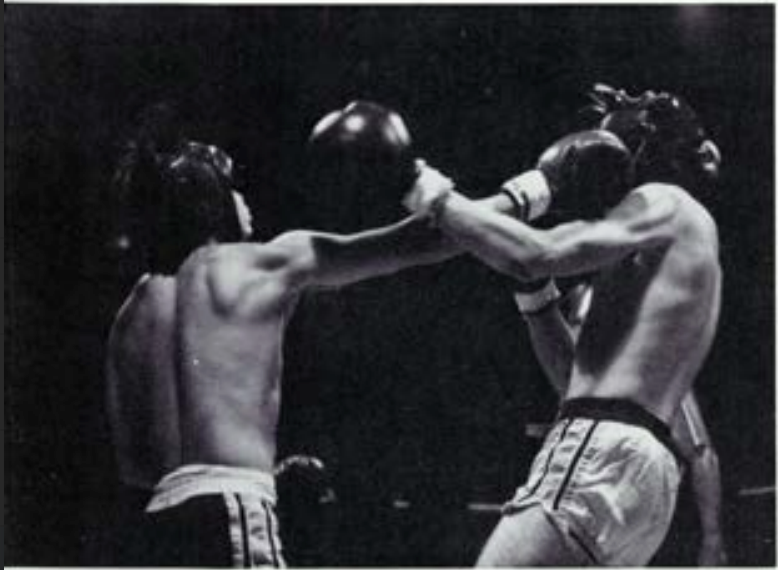
Two Lancers go at it.
For a few short years, from the late 70s to early 80s, Saint Francis hosted the legendary “Sports Spectacular” every spring. Despite the plurality of its title, the event focused on one sport in particular: boxing. The Spectacular consisted of 14 matches between student fighters, each with three ninety-second rounds. As the matches progressed so did the skill of the fighters, always leaving the best fight for last.
The event itself may have only lasted three hours, but students would prepare for weeks. Angelo Aguiar, beloved teacher and coach, was the mastermind behind the entire show, from start to finish. First, there were tryouts where he would select his 28 fighters. Mr. Matt McCormick (’83) had the opportunity to participate in the Sports Spectacular during his freshman and sophomore years, in the spring of 1980 and 1981, and was kind enough to share his experience: “Angelo would do certain things to see what kind of shape you were in. He started off with one that was really difficult. He would make you run the mile, and then he made you run the entire track with your hands above your head, without letting your arms below your ears. If you’ve ever tried doing this, it’s fine for the first 30 steps, but after that, your hands start to get really heavy.” After the fighters were selected, six weeks of intense training began to get them into shape. Practices were about three times a week and focused on getting the students ready to safely compete.
The Sports Spectacular went beyond just the Saint Francis community. Families from all over the South Bay Area, including students from rival high schools such as Bellarmine and Mitty came to witness the madness. The whole event was hosted in the Alumni Gym, which is not the largest arena. McCormick compared getting a ticket to the Spectacular to finding a golden ticket to Willy Wonka’s chocolate factory, which in “Gen-Z speak” is comparable to beating the Ticketmaster queue for the Eras Tour. And, of course, in the 70s and 80s there were no online ticket vendors, so people would line up on campus to secure a ticket for themselves and their families. Because of the popularity and build up to this event, the pressure was on. “They did standing room only so they had the entire gym,” explained McCormick, “imagine all the stands filled. Then they put seats around the ring, which is in the center with a drop down light. Everything was dark on the outside of the ring and the only light was over the ring, so the fighters had a spotlight on them.”
It wasn’t until the night before the Spectacular that the students would find out who their opponents were. McCormick recalls, “That last night that we trained, the very last practice, was kind of an early practice, because it was the next day, and he would basically put [the list with matchups] up on the wall after practice. And he wouldn’t even tell you on the spot. You’d have to come running back to look up there, and you’d see, oh my gosh, okay I’m in the seventh fight, and I’m fighting this guy.” Just imagine the chaos of school the next morning, once everyone found out who would be fighting each other.
Then it was Friday night. Alumni Gym was transformed from an unassuming high school gym to a premiere boxing area with bright lights and a packed crowd. Each match had one fighter on the red team and one fighter on the blue team. These teams added to the competitive spirit: “You’re really supporting those guys because they’re as nervous as you are. You were really getting each other pumped up,” said McCormick. When there were two fights left before a boxer’s bout, it was time to head into the locker room and get ready. In those moments, as they taped their hands and smeared Vaseline across their faces, the boxers had to face the reality that they were about to step into a packed gym and square off against a classmate who was just as afraid to lose as they were. “So you would have all the guys to help you get ready in the locker room as you’re preparing for the fight, and you hear a roar. I mean, when somebody hits somebody good, that gym was like, whoa. I mean, the noise level, and if somebody knocked somebody out, the place was going wild and it almost felt like you were going out into the arena in Gladiator.”
McCormick won both of his fights, despite being up against upperclassmen. He claims his second year was most memorable, when he was against Matt Toves (’82): “He hit me, square up, and I start to hear this ‘Toves, Toves,’ after the first round. Sometimes when you get hit, it wakes you up. So in the second round, it woke me up and I knocked him out.” The fighters were not motivated by money or prizes, but by the next Monday morning at school. Nothing quite motivates a teenager more than being humbled in front of their peers: “I remember during that time, I used to go run the stadium stairs and the track. I tried to get an extra workout in the morning, and then go do school, then go do my sport, and then go workout with the boxers. My biggest fear was being embarrassed in the ring.”
The Sports Spectacular was perfect for its time, but the logistics of the 21st century create a large barrier to any chance of it being repeated. Since the 80s, modern culture has shifted away from promoting violence among teenagers thanks to research on the impact of head injuries to long-term health. The sport of boxing itself also doesn’t hold the same cultural relevance that it did almost half a century ago. There is no doubt that this event would only become more chaotic with the introduction of social media—just imagine the “Almost Friday” post that would come out the day before the fight and the one that would follow the week after. What makes the Sports Spectacular so spectacular is its inability to ever be recreated. McCormick still looks back fondly on his encounter with the event: “It was crazy, crazy energy and it was kind of barbaric but overall a great experience.”