Dominic So ('27)
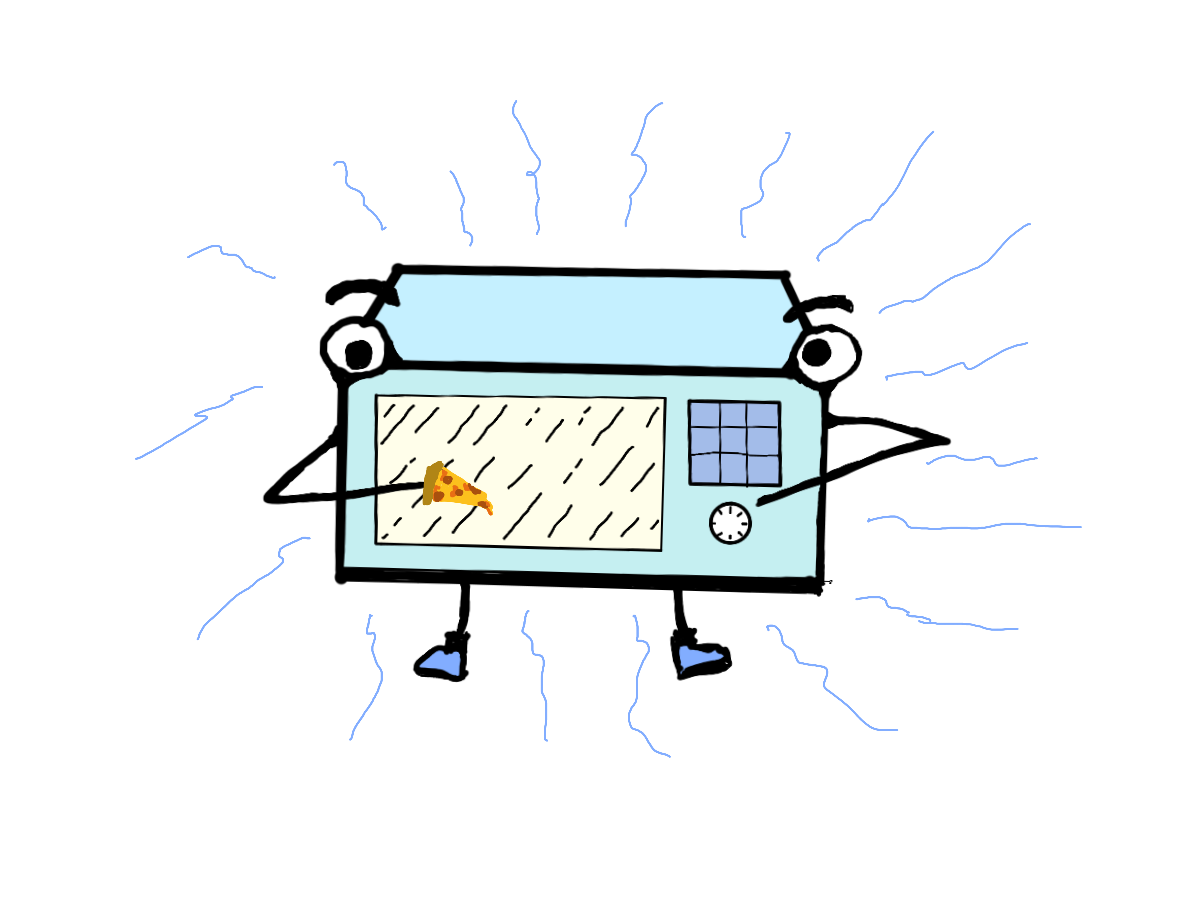
A microwave stares at a reheated slice of pizza.
A face pressed against the glass window, a timer winding down, and on a rotating glass plate… a bean and cheese burrito. Microwave ovens are one of the most popular kitchen appliances today. We rely on them for a variety of culinary ventures from quickly reheating leftovers to softening ingredients like butter. Their convenience is perhaps something taken for granted, because if it weren’t for the efforts of a self-made scientist with a sweet tooth, they may have never been invented.
Percy Lebaron Spencer was born in Maine on July 9, 1894. He was soon orphaned and sent to live with his destitute aunt and uncle. In order to support the family, he dropped out of elementary school at age 12 to work at a spool mill. He gained experience in electrical engineering when he volunteered to install an electrical system for a local paper mill at the age of 16. Two years later, in the midst of World War I, he joined the US Navy as a radio operator. Spencer was fascinated by science and taught himself with whatever textbooks he could get his hands on, exploring topics ranging from calculus to chemistry.
In World War II, the British employed the American Appliance Company (later known as the Raytheon Company) to mass produce the cavity magnetron developed by British physicists in 1940. Cavity magnetrons, an essential component of radar technology, have the ability to eject electrons which travel in a spiral manner due to a strong magnet. An oscillating charge is induced as a result of electrons passing over the metallic cavities of the magnetron, creating a stream of microwaves. The electromagnetic spectrum consists of various types of electromagnetic radiation, which carry energy as waves or particles. Microwaves and radio waves are electromagnetic waves of relatively low frequencies and are less energetic compared to other forms of radiation on the spectrum.
Spencer was employed by the Raytheon Company in 1922, where he earned a reputation as a dedicated and innovative worker. He successfully skyrocketed the production of cavity magnetrons through a special laminating process and increased the overall accuracy and efficiency of radar devices used to detect Nazi aircrafts. In recognition of his work, he received the Distinguished Public Service Award, the highest civilian honor bestowed by the Navy.
In 1945, while standing next to a cavity magnetron, Spencer noticed that a candy bar in his back pocket had melted. Surprised by this development, he began testing other items including popcorn kernels and an egg. The popcorn popped, and the egg exploded on a colleague.
Within the same year Spencer filed a patent with Raytheon for the Radarrange: the world’s first microwave oven. It was a whopping six feet tall and weighed 750 pounds, initially costing about $5000, which is equivalent to almost $60,000 today. It wasn’t until 1967 when the Amana Radarrange compacted the original model for home use.
Microwaves work by exerting forces on charged particles, including polar water molecules present in many foods. The water molecules rotate and vibrate as the positive and negative regions are pushed and pulled in different directions. Frictional heat is generated by the movement of the molecules past one another. Therefore, microwaves have little effect on ingredients like oils which contain nonpolar molecules with no overall separation of charge. Microwave ovens contain cavity magnetrons that expel the microwaves via a metal tube, leading them to bounce off the walls and penetrate the food.
It is important to note that microwaves do not belong to the group of high frequency, ionizing radiation including x-rays and gamma rays and thus are not capable of changing chemical bonds. While the word “radiation” can sound a bit intimidating, it is simply a scientific term for the transfer of electrons through electromagnetic waves. Contrary to some beliefs, there is no sufficient evidence linking cancer to microwave ovens when used properly. Microwaves are designed to be incredibly safe, and manufacturers are required to ensure that there is minimal leakage. Rather, it is ionizing radiation that can have adverse effects on DNA by removing electrons.
The next time you’re reheating Friday night pizza or making instant rice, remember a man who, despite his lack of formal education, relentlessly pursued scientific research and discovery. This contribution continues to impact people around the world today through his innovation. Oh, and don’t forget to thank the candy bar too.