Zhaohua Chen (’27)
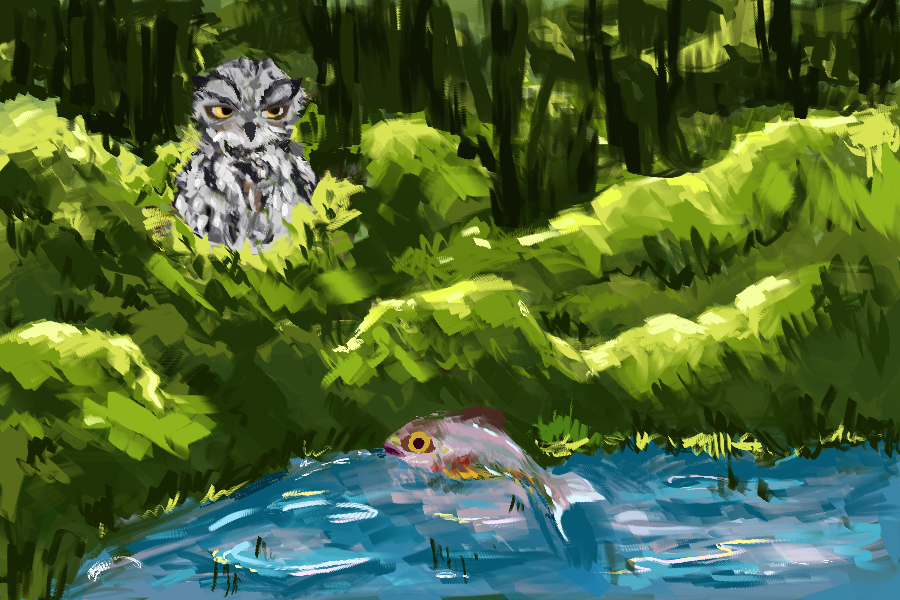
The Western Screech Owl scrutinizes its prey.
During freshmen biology classes, students dissect owl pellets to analyze the contents of the owl’s diet. Picking through the fluff, students carefully remove the bones of small birds and mammals. However, the owl could have actually eaten much more that night, since invertebrates (like moths) and soft-boned organisms (like fish) would not appear in the pellet. In order to get a complete scan of the owl’s diet, researchers must use more methods than just sorting through pellets.
The Western Screech Owl (Megascops kennicottii) is a small bird around the size of a water bottle. Like most owls, it is nocturnal. Its habitat ranges from Central Mexico to the coast of British Columbia. This includes the coastal area of California, which means that you could see one in your own backyard! These birds reside in cavities and mostly live in open woodlands, but they also have been known to live in nest boxes in recreational parks or within neighborhoods. The easiest way to find them is by taking walks at night and listening for a short series of high toots.
Western Screech Owls are considered generalist predators, with a flexible diet of small mammals, insects, mollusks, amphibians, and fish. While this trait seems like it would make them less susceptible to risks posed by climate change—given that if one prey dies out they should theoretically be able to switch to another food source—it unfortunately does not. Like some generalist predators, Western Screech Owls rely on a specific type of prey during crucial life stages. For example, they rely on fish to supply nestlings with the necessary nutrients for fledging—the process in which young birds develop wing feathers capable of flight.
In a study published in June, researchers analyzed the feeding habits of Western Screech Owls using thermosensitive cameras, showcasing one potential way of tracking an owl’s true diet. Through a network of cameras located across 18 owl nests and riparian habitats, researchers found that the majority of the fledglings’ diet was insects 47.1% of the time, not small mammals—which was only 21.8% of the time. Surprisingly, fish were also brought to the nest 10.1% of the time.
Further research also shows the importance of fish to the Western Screech Owl diet, revealing that these birds are the second highest avian predator for rainbow trout, with only the Belted Kingfisher surpassing them. When comparing the spawning season of rainbow trout to the nesting season of the owls, the time during which rainbow trout are most easily caught coincides with the stage of maturation in which the fledgings need the most energy. Coincidence? Probably not. Eastern Screech Owls, a close genetic relative of Western Screech Owls, have a different time in which fledglings need the most energy, one that does not coincide with any fish seasons.
While previous conservation efforts focused on the abundance of small mammals, having fish available is also necessary to preserve the populations of the owls. Although Western Screech Owls are considered to be of least concern for extinction, preserving the annual migration of rainbow trout to streams is essential to their survival. Between 1970 and 2012, there was an 83% loss of freshwater megafauna like the rainbow trout, which is correlated with the decline in Western Screech Owls. By saving this vital fish, we would also be saving the owls.